|
| Typical. |
I love visiting Nami’s household, but it can be sort of
like a time warp. Time slips away at a faster pace than other places, and
before we knew it, we had chatted later into the night than one would
necessarily want, having spent the whole weekend traveling and preparing to get
up at 6 the next morning.
Yeah, 6 am. It turns out (and I wouldn’t have known this
without their help) that it takes a very careful schedule to make the buses and
trains necessary to get to both Okadera (7) and Tsubosaka-dera (6) in the same
day, although they are relatively close together on the map. I was due to take
the same train in the morning as Hiroshi-san was taking to work, so we ate
breakfast like a sort of cobbled-together family… the married couple and their
adopted foreigner little sister, and then he and I hustled to the train
station. I thought we must look funny together, he in his working clothes like
any other Japanese working guy, me with my pack and walking shoes like any
other tourist… neither is a particularly rare sight in Kyoto-Nara area, but to
walk and talk and sit together on the train is something else. Nami-san waved
to us from the balcony of their apartment as it flashed by, and we were off.
My first destination was Okadera, one of the oldest
temples on the route snugged up in the mountains of Asuka, which is the most
ancient first capital of Japan (and you thought it was Nara..! Well, I did
anyway). Asuka, it turns out, is an area full of ancient things, archaeological
stuff. Other than that, it’s as countryside as countryside can be, which is why
the public bus runs only a handful of times a day on such narrow roads and was
so sparsely filled.
 |
| Attempt to capture the field of lotus blooms... fail. |
Okadera was perhaps the first temple I was earnestly able
to make it to in the morning. The feel of the place as I walked up (sweaty as
ever, despite the morning hour, having gotten a little lost
already thanks to some construction work)
was relatively empty; I paid my entrance fee as though I had managed to catch a
tourist spot unpopulated for the first time in Japan.
 |
| The main hall from above on the mountainside. |
What set in my mind first was the mountain-garden feel of
the pathways I followed through the woods there, and the insects.
Okadera is famous for protection against disasters, and I
saw part of what I think was a ceremony or prayer for a woman at one of the
vulnerable ages. There is a list of the vulnerable ages for women and men on
the bell tower; I’ve seen these lists before, and Okadera is pretty big for
trying to make sure those bad years go well. I was pretty sure I heard the
priest say “thirty-three” during his chanting, so I sat still and listened for
a bit because I find the chanting and bell ringing that goes on pretty
soothing.
 |
| View of Asuka from near the pagoda. |
Okadera is also perhaps the first temple where I was able
to see the main image of Kannon. At many of these temples, the image is not
seen except every 33 years or so (some places, not at all, ever), but at
Okadera, she is in full view all the time. The statue is a large clay image,
the largest clay statue in Japan, and it has a really earthy look and energy
about it. It has been restored often, but has essentially survived since the 700s,
which is what gives it the reputation for protection against disaster.
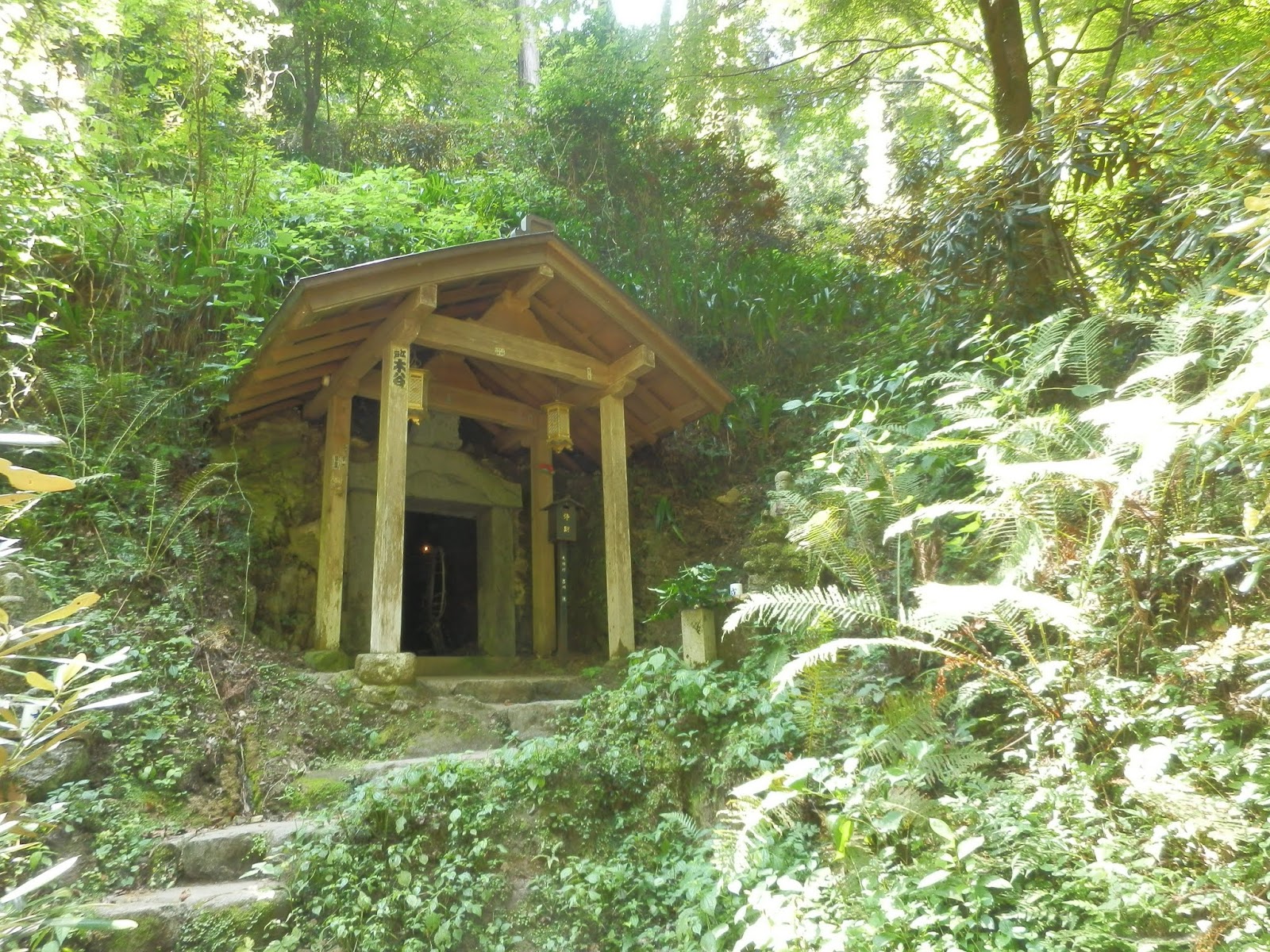
I took my time exploring around a bit, eventually coming
to the Okunoin further up the hill. That’s the inner sanctuary, which is often
tucked away somewhere further up the mountain. This one was a little cave which
went back into the earth rather farther than I expected from looking at the
front of it. There’s a small statue inside of the Buddha of the future, and an
older couple who was praying in there ahead of me (I waited til they finished
because there was actually not enough room for more than two people side by
side in front of it, plus I always feel awkward when those I regard to be the
‘legit Buddhists on legit business’ are doing their thing and I’m just
wandering around spectating) gave me a piece of tarp to sit on because the cave
was damp and puddle-y. After sitting inside a little while, I stood up and
noted how the cave at that point was just barely tall enough to accommodate my
height, though I couldn’t walk upright through the cave. Then I noticed just
just above my head a pair of the biggest
effing camelback crickets I have ever seen, and I crouched right the hell back
down, packed up my piece of tarp, and with one more bow, hurried back out into
the light.
 |
| Entrance to the cave... |
So, yep, bugs and mountain-garden foresty earthiness. It
was a beautiful place and I’m glad I got to go in the morning when it was so
quiet and peaceful.
I next caught another bus to a tiny train station
(Asuka), from which I was to proceed by train to another train station
(Tsubosaka-yama) and wait for a more different bus, which would not come until
1:15, although I had to get on the first of these buses at 11:06. This meant I
would have time for lunch in the train station area, and here is where I made a
Saiou’s Horse kind of mistake.
Asuka station was flanked by your usual handful of little
restaurant places, none of which looked particularly good, so I decided to eat
in the area of the second station. Getting off the train in that area, I looked
around, noted it to be a touristy-looking street ahead of me, and decided to
wander til I found something, since I had nearly two hours to kill. The sign
above the road said that the town was one of “sightseeing and medicine,” which
I thought odd, but shrugged off and began to walk with my little parasol
overhead. I wandered in a sort of loop for twenty minutes or more, finding that
every single likely looking place I came upon was not a restaurant, but instead
a hair salon, dentist, or other treatment facility, and half were closed. There
had been one well-marked restaurant just by the station, but the sign on the
door said “closed today.” Ah the perils of traveling on quiet weekday
afternoons.
 |
| Oh why are you closed...? |
I returned to the station along a sweaty, perilous
highway with a tiny sidewalk and asked the station guy about food. He pointed
to the tiny closed place and I protested its closedness. He shrugged sadly
saying, that was it. I sat down on a bench to reconsider. This was crazy. Not
eating was unacceptable; I would have to find a combini or something.
It was then I remembered that I do have a smartphone and
it is good for more than just email and mapping exactly where I am. It also has
a ‘find restaurants in my area’ function, of course. I put it to the test. The
first listing was for a place half a kilometer away, not so bad, and a ten
minute walk according to the review written in Japanese. The place was just
past where I’d come upon the perilous, sweaty highway, and I did not relish
taking that walk only to find the place ALSO CLOSED, so I did the thing I
always dread doing, prepared myself for Japanese and phoned the place. I was
about to give up hope when an animated voice answered pretty late in the
ringing cycle, confirmed that they were open, and that it was a ten minute walk
from the station. I needed no more than that, and set off.
The place was across from a combini, and I briefly
considered grabbing some quick food there instead, because now I was beginning
to worry I wouldn’t be back at the station in time to catch the bus at 1:15 if
I had heard right and the restaurant I was headed for would take some time in
food preparation. But I thought I saw a bus stop sign just a little further
ahead and felt sure it must be on the route I wanted, right? And if it all went
to hell I’d just call a taxi and catch up with my schedule later.
I then stepped into the restaurant and had the best damn
udon I’ve ever eaten, and I’ve been to Shikoku AND I don’t even like udon, but
I was supremely glad I hadn’t given up and gone to Lawson’s. The lone guy
running the place was apparently making the stuff from scratch, and it was a
beautiful thing. If you are ever in the western end of I-think-I’m-lost Nara
prefecture, I give it a thumbs up.
My food was ready in about perfect time for me to eat it,
pay, and get to the bus stop which was in fact the bus I wanted, which took my
up the winding paths to Tsubosaka-dera. Tsubosaka-dera was, once again, totally
different from the other temples I had been to so far, especially in its
palpable connection to India and Indian Buddhism. Without really solidifying in
my head what that image is, I have formed an idea of what a Japanese Buddhist
temple looks like, but Tsubosaka-dera does not look like that. The imagery was
different, the atmosphere followed suit.
This temple is connected especially with sight and eyes,
not only in the prayer sense, but also in the very real sense that there is a
home for the blind on the premises. The connection to India is in their ongoing
support of programs in India. This temple therefore felt like a museum in some
ways (I mean, there was a wall, a relief carved wall with stories from Buddha’s
life!), but also like a functioning thing, not a relic.
 |
| This statue is related to a legend associated with the temple about a man healed of his blindness. |
Maybe because it was a weekday afternoon and tucked far
away up on this mountain, but there were hardly any other visitors that I could
see. I walked around a little and made my way to the main hall, where I slipped
in quietly and looked around. The main statue here is also visible to those in
the hall at all times, this one because it is meant to be
seen, in connection with its healing for sight issues. Just as I
was about to head out and explore the grounds some more, a large group of
older-ish Japanese folks had massed at the entrance, looked like they had come
by big tour bus, and were being given a short lively speech by the guy I’d
nodded to solemnly on my way in. I passed the merry crowd and walked again
through an area that made me think someone was burning lavender incense until I
realized I was surrounded by lavender plants being baked in the sun.
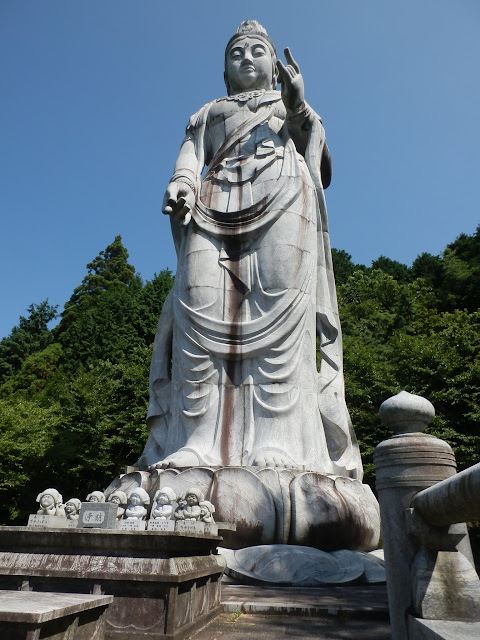 |
| Made in India, actually, then shipped over and reassembled in Japan. |
I checked out the great Kannon, and reclining Buddha, and
inspected the building that is covered with tiles made to imitate the ancient
tile found in the area, and tried some of the eye-healing tea. I knelt on the
power stone, and asked for clearer sight, to which I swear I heard Kannon-sama
chuckle and say, get lasik, you.
The last bus out was at 3pm, which I at the time thought
a bit strict, but found to be perfectly timed for me that day. I bought a
bottle of Tsubosaka spring water and beat it toward Hasedera. The final walk to
my ryokan for the night was pretty sweaty, given that I was wearing a backpack
and walking for over a kilometer even if it was through cute streets (the kind
that lead the way to important temples or shrines that get a lot of visitors…
these kinds of streets develop with gift shops and inns and restaurants to
serve the travelers, even from really old times). It was just after the heat of
the day and I was beat.
 |
| I took this before she brought the soup out even. |
I was the only guest that night at Yoshinokan, so I had a
little tatami room all to myself. I bathed, put on the provided yukata, and ate
my fancy Japanese dinner while watching the Olympics with the proprietess. Then
I took a little walk up to Hasedera’s steps and back along the small river. I
thought maybe it was kind of neat to have walked up to temple number eight on
August 8
th, even if I wouldn’t really go in til the following day.
Nami-san had set me up to stay the night basically at the temple doorstep
so I could attend the morning prayer
service which is open to the public.
Once darkness had fallen, I retired to my room and
happily conked out at about 8pm (perfect for a 5:45 wakeup, if you ask me!).