Showing posts with label Nara. Show all posts

Sunday, August 26, 2012

Hasedera (number eight) and the bonus temple


Having passed out early, I had no trouble getting up extra early the next morning. I dressed and slipped out about 6 to make my way up the steps. I went around the side entrance because I thought the blocked main gate still applied to me, and heard chanting coming from one of the buildings off to the left. I found my way to the main hall where I looked stupid until someone was kind enough to take me in hand and tell me where to go to get my ticket.

The street to Hasedera at six am.
It was a Thursday at 6:30, so I was the only guest at this morning event. Every monk that passed me bowed and said good morning in a way the reminded me of being at school, and how the kids are always told to give a really energetic greeting (in fact, one of the monks struck me as really young.. like maybe middle school age, and I thought, what the hell, why isn’t that kid in school?! until I remembered it is summer vacation right now ^_^). I couldn’t tell if the guy sitting just next to me explaining stuff was high ranking or just exempt from some of the niceties in order to take care of me, but he was never the first to say good morning. He handed me a book in which was written the text of the prayers and chanting, including in some parts these little notations for how the syllable was held and whether the note went upward or downward or squiggled.

This is the area where we were assembled. I was sitting in front of that thingy at far right, with my back to it.

He showed me where the leader would speak and where the assembled monks on the area where I was sitting (and theoretically I too) would respond or be chanting. He explained how the second part would be chanting along to a drum beat from within the temple. Then we had a little extra time so he told me about the temple building itself, how old the statue was (third temple in a row where the main image was just right there in front of you), and some other features of the place. I nodded a lot, said ‘hai,’ a lot, and was glad I already knew gassho-rei from kempo practice (that’s the kind of bow that isn’t so much a bow as a hand position).

My Japanese isn’t good enough to chant along, especially once that fast paced drum got going, but I did like listening to all the monks chanting together around me, and I followed along in the cool book he had given me (which was folded kind of accordion-style, so turning the pages was also an act of stretching and I could look at as few as two, as many as maybe six pages at a time! Useful when I lost my place). After this, we did a sort of morning salutation prayer (I think?) standing and facing the mountains in a few different directions visible from the main platform.

This is a photo of a sun-worn poster, but it shows what that part looked like.
Stairs.

Afterward, I walked down the main path with its 399 stairs, falling into step beside an older guy who talked with me pleasantly a little bit about where I lived and what I did before bidding me good morning and disappearing off a side path. I took the rest of the steps and returned to the ryokan for breakfast.

I always take the photos sans soup.

After breakfast, I went back up to the temple to explore some more, seeing as how I had no further buses to catch. Hasedera is called the Flower Temple, and I could see where lots of things could be blooming at different times of the year. Naturally in August only the cicadas were in full bloom beneath the swelter of the sun. The mountain trees, though, gave a nice shade to my wanderings.

The whole place is beautiful, though, and has a calm, sweet feel. I like the way the main image of Kannon is holding Jizo’s staff (according to my sources, this is rare) symbolizing her ability to travel to any place at any time. (Click that link to see a photo)

While I was getting my stamp and seal, I was asked if I knew about the “ban-gai.” These are three temples listed in the back of the seal book, not counted amongst the 33, but which are still part of the pilgrimage for other reasons. That ‘gai’ is the same as the gai in gaijin, and it just means ‘outside’ .. so the ban-gai are the temples outside the ‘ban’ or order/numbering. I know almost nothing about the ban-gai even now, and knew utterly nothing then other than that there were some.

He explained that one of the ban-gai temples was located just down the road (and in fact, basically right next to my ryokan), so I shrugged and thought, I’ve been to two temples every time so far, why not keep that tradition going? I do feel a little weird about going to temples I have absolutely no information about. I always look to the Sacred Japan website in order to sort of ground my travels; it’s almost a ritual now. On the bus or train to a place, I peer into my smartphone and read (or in most cases review) what is said there about whatever temple I’m on my way to. It makes the whole experience a bit more meaningful.

After all this, I made the same mini trek to the train station, which was no more fun in reverse being as it was late morning and this time uphill. I returned to Nami-san’s house with the intention of going farther, but I never made it and ended up just hanging out with her and Hiroshi-san all evening and staying another night. It didn’t occur to me til then that I might not see them again for a while, and I just couldn’t get myself out the door with that in mind.

Monday, August 20, 2012

Temples number Six and Seven: Okadera and Tsubosakadera

I returned to Kyoto on Tuesday evening, arriving at Nami’s at just the time I had planned to on the first calendar (that is, the one that had me in Tokyo from Saturday until Tuesday early morning), and so things resumed as planned from there.


Typical.
I love visiting Nami’s household, but it can be sort of like a time warp. Time slips away at a faster pace than other places, and before we knew it, we had chatted later into the night than one would necessarily want, having spent the whole weekend traveling and preparing to get up at 6 the next morning.

Yeah, 6 am. It turns out (and I wouldn’t have known this without their help) that it takes a very careful schedule to make the buses and trains necessary to get to both Okadera (7) and Tsubosaka-dera (6) in the same day, although they are relatively close together on the map. I was due to take the same train in the morning as Hiroshi-san was taking to work, so we ate breakfast like a sort of cobbled-together family… the married couple and their adopted foreigner little sister, and then he and I hustled to the train station. I thought we must look funny together, he in his working clothes like any other Japanese working guy, me with my pack and walking shoes like any other tourist… neither is a particularly rare sight in Kyoto-Nara area, but to walk and talk and sit together on the train is something else. Nami-san waved to us from the balcony of their apartment as it flashed by, and we were off.

My first destination was Okadera, one of the oldest temples on the route snugged up in the mountains of Asuka, which is the most ancient first capital of Japan (and you thought it was Nara..! Well, I did anyway). Asuka, it turns out, is an area full of ancient things, archaeological stuff. Other than that, it’s as countryside as countryside can be, which is why the public bus runs only a handful of times a day on such narrow roads and was so sparsely filled.


Attempt to capture the field of lotus blooms... fail.
Okadera was perhaps the first temple I was earnestly able to make it to in the morning. The feel of the place as I walked up (sweaty as ever, despite the morning hour, having gotten a little lost already thanks to some construction work) was relatively empty; I paid my entrance fee as though I had managed to catch a tourist spot unpopulated for the first time in Japan.


The main hall from above on the mountainside.
What set in my mind first was the mountain-garden feel of the pathways I followed through the woods there, and the insects.

Okadera is famous for protection against disasters, and I saw part of what I think was a ceremony or prayer for a woman at one of the vulnerable ages. There is a list of the vulnerable ages for women and men on the bell tower; I’ve seen these lists before, and Okadera is pretty big for trying to make sure those bad years go well. I was pretty sure I heard the priest say “thirty-three” during his chanting, so I sat still and listened for a bit because I find the chanting and bell ringing that goes on pretty soothing.

View of Asuka from near the pagoda.
Okadera is also perhaps the first temple where I was able to see the main image of Kannon. At many of these temples, the image is not seen except every 33 years or so (some places, not at all, ever), but at Okadera, she is in full view all the time. The statue is a large clay image, the largest clay statue in Japan, and it has a really earthy look and energy about it. It has been restored often, but has essentially survived since the 700s, which is what gives it the reputation for protection against disaster.

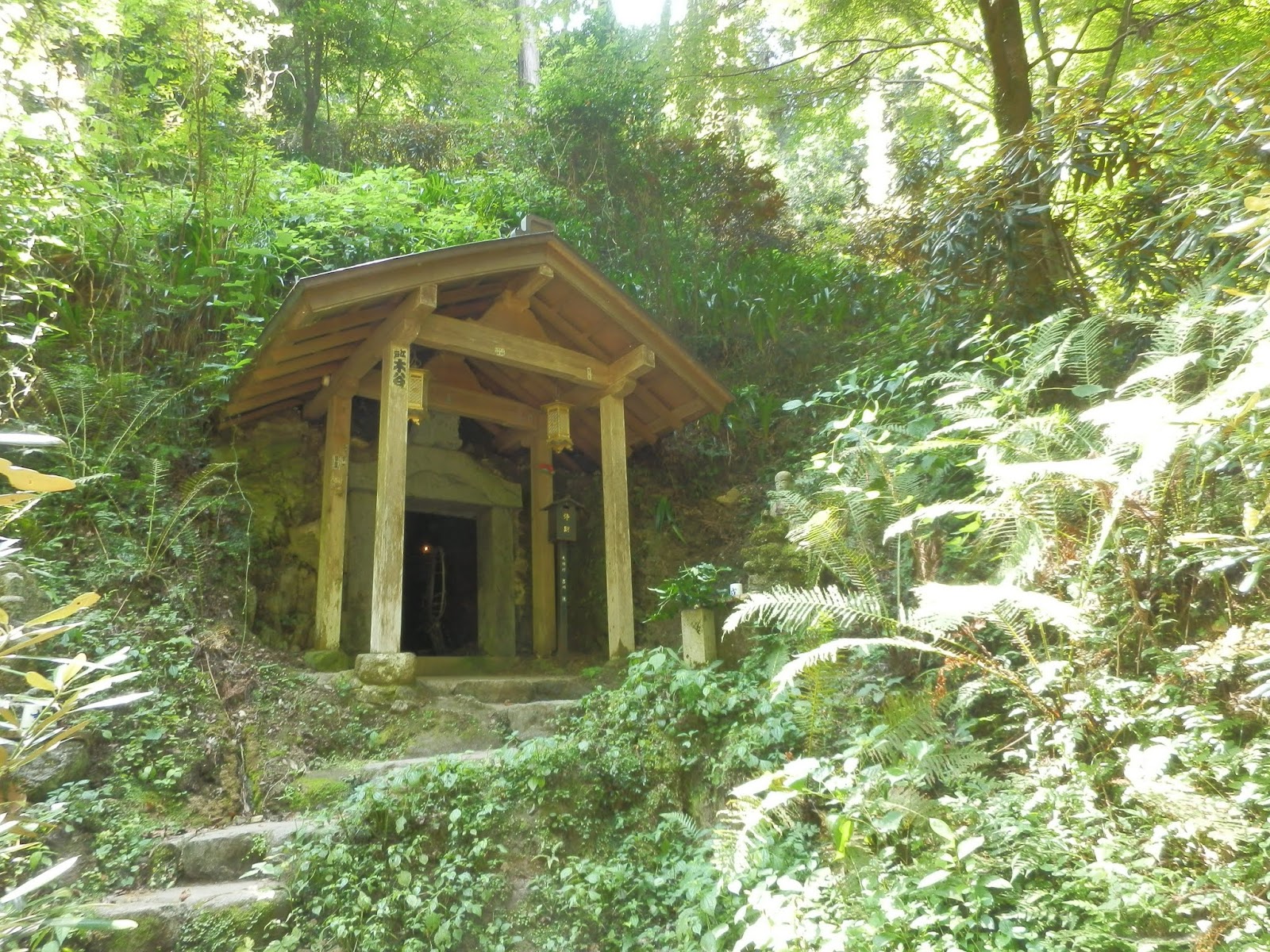
I took my time exploring around a bit, eventually coming to the Okunoin further up the hill. That’s the inner sanctuary, which is often tucked away somewhere further up the mountain. This one was a little cave which went back into the earth rather farther than I expected from looking at the front of it. There’s a small statue inside of the Buddha of the future, and an older couple who was praying in there ahead of me (I waited til they finished because there was actually not enough room for more than two people side by side in front of it, plus I always feel awkward when those I regard to be the ‘legit Buddhists on legit business’ are doing their thing and I’m just wandering around spectating) gave me a piece of tarp to sit on because the cave was damp and puddle-y. After sitting inside a little while, I stood up and noted how the cave at that point was just barely tall enough to accommodate my height, though I couldn’t walk upright through the cave. Then I noticed just just above my head a pair of the biggest effing camelback crickets I have ever seen, and I crouched right the hell back down, packed up my piece of tarp, and with one more bow, hurried back out into the light.

Entrance to the cave...
So, yep, bugs and mountain-garden foresty earthiness. It was a beautiful place and I’m glad I got to go in the morning when it was so quiet and peaceful.

I next caught another bus to a tiny train station (Asuka), from which I was to proceed by train to another train station (Tsubosaka-yama) and wait for a more different bus, which would not come until 1:15, although I had to get on the first of these buses at 11:06. This meant I would have time for lunch in the train station area, and here is where I made a Saiou’s Horse kind of mistake.

Asuka station was flanked by your usual handful of little restaurant places, none of which looked particularly good, so I decided to eat in the area of the second station. Getting off the train in that area, I looked around, noted it to be a touristy-looking street ahead of me, and decided to wander til I found something, since I had nearly two hours to kill. The sign above the road said that the town was one of “sightseeing and medicine,” which I thought odd, but shrugged off and began to walk with my little parasol overhead. I wandered in a sort of loop for twenty minutes or more, finding that every single likely looking place I came upon was not a restaurant, but instead a hair salon, dentist, or other treatment facility, and half were closed. There had been one well-marked restaurant just by the station, but the sign on the door said “closed today.” Ah the perils of traveling on quiet weekday afternoons.

Oh why are you closed...?
I returned to the station along a sweaty, perilous highway with a tiny sidewalk and asked the station guy about food. He pointed to the tiny closed place and I protested its closedness. He shrugged sadly saying, that was it. I sat down on a bench to reconsider. This was crazy. Not eating was unacceptable; I would have to find a combini or something.

It was then I remembered that I do have a smartphone and it is good for more than just email and mapping exactly where I am. It also has a ‘find restaurants in my area’ function, of course. I put it to the test. The first listing was for a place half a kilometer away, not so bad, and a ten minute walk according to the review written in Japanese. The place was just past where I’d come upon the perilous, sweaty highway, and I did not relish taking that walk only to find the place ALSO CLOSED, so I did the thing I always dread doing, prepared myself for Japanese and phoned the place. I was about to give up hope when an animated voice answered pretty late in the ringing cycle, confirmed that they were open, and that it was a ten minute walk from the station. I needed no more than that, and set off.

The place was across from a combini, and I briefly considered grabbing some quick food there instead, because now I was beginning to worry I wouldn’t be back at the station in time to catch the bus at 1:15 if I had heard right and the restaurant I was headed for would take some time in food preparation. But I thought I saw a bus stop sign just a little further ahead and felt sure it must be on the route I wanted, right? And if it all went to hell I’d just call a taxi and catch up with my schedule later.

I then stepped into the restaurant and had the best damn udon I’ve ever eaten, and I’ve been to Shikoku AND I don’t even like udon, but I was supremely glad I hadn’t given up and gone to Lawson’s. The lone guy running the place was apparently making the stuff from scratch, and it was a beautiful thing. If you are ever in the western end of I-think-I’m-lost Nara prefecture, I give it a thumbs up.


My food was ready in about perfect time for me to eat it, pay, and get to the bus stop which was in fact the bus I wanted, which took my up the winding paths to Tsubosaka-dera. Tsubosaka-dera was, once again, totally different from the other temples I had been to so far, especially in its palpable connection to India and Indian Buddhism. Without really solidifying in my head what that image is, I have formed an idea of what a Japanese Buddhist temple looks like, but Tsubosaka-dera does not look like that. The imagery was different, the atmosphere followed suit.


This temple is connected especially with sight and eyes, not only in the prayer sense, but also in the very real sense that there is a home for the blind on the premises. The connection to India is in their ongoing support of programs in India. This temple therefore felt like a museum in some ways (I mean, there was a wall, a relief carved wall with stories from Buddha’s life!), but also like a functioning thing, not a relic. 

This statue is related to a legend associated with the temple about a man healed of his blindness.
Maybe because it was a weekday afternoon and tucked far away up on this mountain, but there were hardly any other visitors that I could see. I walked around a little and made my way to the main hall, where I slipped in quietly and looked around. The main statue here is also visible to those in the hall at all times, this one because it is meant to be seen, in connection with its healing for sight issues. Just as I was about to head out and explore the grounds some more, a large group of older-ish Japanese folks had massed at the entrance, looked like they had come by big tour bus, and were being given a short lively speech by the guy I’d nodded to solemnly on my way in. I passed the merry crowd and walked again through an area that made me think someone was burning lavender incense until I realized I was surrounded by lavender plants being baked in the sun.


Made in India, actually, then shipped over and reassembled in Japan.
I checked out the great Kannon, and reclining Buddha, and inspected the building that is covered with tiles made to imitate the ancient tile found in the area, and tried some of the eye-healing tea. I knelt on the power stone, and asked for clearer sight, to which I swear I heard Kannon-sama chuckle and say, get lasik, you.


The last bus out was at 3pm, which I at the time thought a bit strict, but found to be perfectly timed for me that day. I bought a bottle of Tsubosaka spring water and beat it toward Hasedera. The final walk to my ryokan for the night was pretty sweaty, given that I was wearing a backpack and walking for over a kilometer even if it was through cute streets (the kind that lead the way to important temples or shrines that get a lot of visitors… these kinds of streets develop with gift shops and inns and restaurants to serve the travelers, even from really old times). It was just after the heat of the day and I was beat.

I took this before she brought the soup out even.
I was the only guest that night at Yoshinokan, so I had a little tatami room all to myself. I bathed, put on the provided yukata, and ate my fancy Japanese dinner while watching the Olympics with the proprietess. Then I took a little walk up to Hasedera’s steps and back along the small river. I thought maybe it was kind of neat to have walked up to temple number eight on August 8th, even if I wouldn’t really go in til the following day. Nami-san had set me up to stay the night basically at the temple doorstep so  I could attend the morning prayer service which is open to the public.

Once darkness had fallen, I retired to my room and happily conked out at about 8pm (perfect for a 5:45 wakeup, if you ask me!).

Saturday, August 11, 2012

the first post-trip and the pilgrim trail

Ever since my packing adventure ended, I've been running all about on what I consider to be one big trip. I left my computer in Shiso, though, so I don't have the capacity to process my photos yet! I want to write posts about all my adventures, including the two-temples-a-day I've been visiting every day I've been in Kyoto and Nara. Those posts alone will take a while.

Basically I've been from Shiso to Kyoto to Tokyo and back to Kyoto (and Nara) again. After leaving my apartment I discovered that, far from 'homeless' as I joked I'd be, I actually have lots of wonderful friends who have lots of wonderful futons and floorspaces for me. It's been like an extra-extra long weekend of all kinds of awesome (more prevalent kind being, the sweaty kind).

So I'm taking in culture, and lots of temples (each of which has its own 'meaningful nickname' .. oh yes), and while I don't know if my 33 will be complete by the time I leave, at least the map is taking on a more obvious shape. The temples that are easy to get to are being visited, the remaining are being saved for.. later. Tokyo was better than I remember (maybe it's always better than I remember, because I remember it so negatively). I just feel like I'm seeing and getting to do so much, and almost always with people I genuinely like, which can make all the difference in the world.

So until I can download (and upload) the photos, I won't be going into super detail, but just as an outline!

F 8/3 clean house like a crazy person, 'move' to Lorr's.
S 8/4 Finish sorting things (without access to house), hang out with Lorr, go to Rocky's, head to Kyoto.
S 8/5 Two temples (Ishiyama dera and Mii dera), the first with Miriam. Dinner by the canal in Kyoto.
M 8/6 Go to Tokyo, lunch with Loco, help out at orientation.
T 8/7 Museum with Mark, head back to Nami's in Kyoto.
W 8/8 Complicated transportation schedule to get to two temples (Okadera, Tsubosaka dera), finish at a ryokan outside Hasedera.
R 8/9 Morning prayer service at Hasedera, exploration of Hasedera, with bonus tiny "bangai" temple thrown in. Back to Nami's.
F 8/10 Back to Miriam, to Rokuharamitsu-ji and Rokkaku-do (the first with Miriam).
S 8/11 - That's today! The plan is to visit Daigo-ji, and possibly pop off the train line for a visit to another bangai temple. And a totally unrelated temple Miriam said is cool!

Tomorrow is back to Lorr and Shiso to hopefully unwind.

Thursday, April 12, 2012

The Re-Visit II (temple nine)

The second re-visit temple on the pilgrimage route that my parents and I visited was number nine, Nan'en-do. My first visit to Nanen-do that I remember was in March of last year (I might have walked through or by it in December of 2010, but I don't have any photos if I did), almost immediately following the March 11th disaster in north Japan.

Back then, I didn't have a book yet, but actually my trip to Nara on March 12th and 13th was what prompted me to buy the book in the first place, so it's kind of connected. If you recall, I had planned to visit Nara for Omizutori, which always takes place on the night of March 12th, but which only sometimes falls on a Saturday. I had decided to book a hostel and take advantage of my timing of being in-country for one such Saturday.

While we were waiting for 2am, T-rav told me about how you can get stamped, sealed, calligraphed pages from the temples as you visit them, how lots of people have a book where they collect these. It was his explanation that prompted me to buy the pilgrimage book without really knowing what it was, because I thought it was a book of all the major temples in the area (not totally wrong) or all the temples of a certain sect or something. Nigatsu-do, the place we visited that night, is not part of the Kannon Kansai 33, but the following morning's wandering did include Nanen-do, which was.


The pagoda for Kofuku-ji, I believe.
The way Nanen-do will be in my pilgrim book reflects the scattered nature of my visit there. On the re-visit, part of my day in Nara with my parents, I remembered too late that I had forgotten my book even though I knew there was a temple in the area. I then thought it was Kofuku-ji, to which Nanen-do is a sort of offshoot; Kofuku-ji is under construction and a bit confusing for that (last March I visited the museum shop without going to the treasure house museum and stocked up on Kofuku-ji postcards for some reason).


From the side.


The style of Nan'en-do makes it different from most of the other stops I've gotten to, as does its location off to the side of Kofuku-ji. I don't have much information to offer about the place, other than it's very photogenic, and that's how it caught my eye back in March.

So we did two re-visits this not-yet-spring, both to temples I had visited without stamping my book for whatever reason, both on the first weekend following one kind of sad event or another.

Saturday, June 4, 2011

Omizutori

Omizutori is a famous event at Nara's Nigatsudo. My visit to this event has its roots in the first time I visited Nara, on Christmas 2010; our guide Osaki-san pointed out the blackening around the wooden rafters of Nigatsu-do.

お水取り, Omizutori, quite literally is the drawing forth (tori) of water (mizu), but the most famous and pictorally represented aspect of this yearly festival is the part where stuff is on fire (which is actually called Otaimatsu). Priests walk huge flaming torches back and forth along the porch of Nigatsu-do and shake them in certain places. If you have sparks fall on you, it's supposed to be good luck.

Different combinations of the spectacular event happen on different days, but the 12th presents 11 torches instead of 10, and visitors are circulated through by the crowd control machine that is the Japanese Way. Other nights, you just have to get there early and camp out if you want to see anything. The 12th is also the night of the "mysterious" water-drawing ritual, or actual Omizutori. Which happens at about 2am, making it a lot less accessible (trains don't run after about midnight, so you are walking or taking cabs from that time on.. and you better be staying the night in Nara, for this). I decided that I wanted to see it this year, because I was never going to travel all the way to Nara on a school night and stay up til 2, and this year, the 12th of March fell on a Saturday.

Nigatsu-do is part of Nara's iconic Todai-ji, home of the huge Buddha. 二月堂, Nigatsu-do is literally the hall (do) of the second month (nigatsu). And before you say, well then why do they have all their special events in March (三月), allow me to introduce myself: Hi, I'm Emily, and I'm obsessed with calendars.
HI!


I discovered this preoccupation most solidly when I chose the fasti as my topic for study and presentation in the ICCS Rome program (I just went looking for that photo and saw some rad photos which make me amazed again that I got to go to that program!), but here in Japan, it just means that the New Year's gift of a horoscope calendar book (given by one of my adult students) was very well placed. To make a short story long, the old Japanese calendar had 1/1 this year on our Gregorian February 3rd, so the old calendar's "second month" would actually be happening in the modernly conceived "third month," and so on. (If you care about this as much as I do, check out the wiki page on it too.)

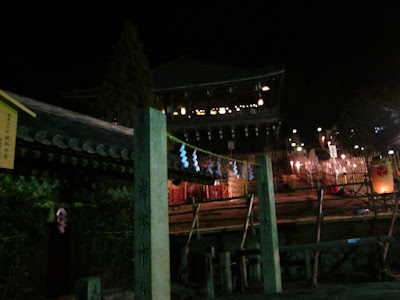
So Nigatsu-do is pretty much named after its biggest event, the March drawing of mystical water. The water actually comes out of an unassuming-looking building at the bottom of the steps leading up to the hall.

You can see the well house at the bottom of the steps, to the right.
From 2010_12_25

And of course I was going to see that. Flash and fire and accessibility may seem awesome, but quiet mystical water is more my bag. Who needs trains? I'll walk across the city, my 10am wakeup be damned.

Now as you may already be mentally protesting to your silly blogging author, the 12th of March this year also happened to fall on the day after the 11th of March, which would be the day that a massive earthquake and tsunami completely tore apart the north-eastern part of the country. And I went to Omizutori anyway. I don't have much to say for that, other than there didn't seem to be much reason to cancel the plans. My traveling companion and I saw the last few torches, I took some grainy video, and then we put on every last layer we could find, and settled in to wait.

Spent some of that time exploring the area around Nigatsu-do, got a calligraphy page (as mentioned in the pilgrimage post), managed to get in to one of the small rooms around the outer wall of the hall, where we could hear the priests chanting and clattering around in their wooden clogs inside, and could see only the glow of maybe candles through the slats. The chanting was hypnotic. We meditated, we sat. It was cold. We had some sweet bean mochi and tea at a little shop that was staying open all night. Then we went down and camped in a spot right next to the door of the well house.

View from our sweet standing space, before the lights were turned out.
From 2011_03_12

Part of the reason Otaimatsu is more photographed is that the actual Omizutori prohibits flash, and is very very dimly lit. They extinguish all the electric lights and proceed by torch up and down the steps, drawing the water and carrying it up to the hall, in all three times. 

I took some video, partly because the lighting prevented any but the blurriest photos, and partly because I wanted to get the unearthly droning of the musical accompaniment. If you click through here, it'll only take you to the album associated with the post-midnight stuff. For pre-midnight, click the photo up above.

By the time they were finished drawing the water, it was way too cold and I was not Buddhist enough to attend the Dattan part of it, especially because I thought it would be a lot like the earlier meditation time, and we would need special badges to get in, which we did not have (and which we had not needed previously only because one of the door guys took pity on our idiocy). So we grabbed a cab back to the hotel and hostel area.

I assumed the following day would be a too-tired-to-enjoy wash, but it was actually really nice. We walked around Nara, checked out some lovely park areas, skipped a museum, and enjoyed the sunshine until it was time for dinner (Vietnamese!).

Wednesday, December 29, 2010

Christmas in Nara

Nara is like the poor man's Kyoto. ~somebody

Nara was the capital before Kyoto was the capital (which was before Tokyo was the capital) of Japan. So what's left there is mostly very old stuff, some temples and other cultural property from when Nara was the most prestigious place to be. It's a lot smaller than Kyoto, and the feel of it is a bit less pretentious. You can take it all in within about one day, whereas Kyoto requires a lot more time (and cash).

I had never been before this Christmas, which was the reason Osaki-san offered to take me. M joined up as well and the three of us used train tickets that function kind of as all-day passes. It was snowing very lightly as we left, and I worked on New Year cards on the train.

Our first stop was Horyu-ji, a very spacious temple area with a cool onsite museum full of historical art stuff. Horyu-ji is home to the oldest surviving wooden building in the world! Wiki-travel says to expect to wait in line to get in, but we wandered about at will in the chilly December wind. The grounds were very lightly populated with tourists, and a light snow continued to fall at intervals.

It was pretty magical.

From 2010_12_25


From 2010_12_25


From 2010_12_25


From 2010_12_25


From 2010_12_25


From there, we had lunch, tried to unfreeze our hands, and hopped a train the rest of the way into Nara.

There were deer everywhere, a thing for which Nara is known. I was told they would bow to passersby, hoping for a handout, like a dog that gets so excited when it sees you holding a treat it spontaneously beings doing all the tricks it knows, hoping one of them is the one you're about to say.

From 2010_12_25


They didn't bow much, but I figured that would change once I bought some treats. Later.

First, Todaiji.
From 2010_12_25


We went into the temple and wished Daibutsu (literally, Big Buddha) a merry Christmas.
From 2010_12_25


Inside the temple, Osaki-san showed me the pillar hole which Miriam said was the size of Daibutsu's nostril, and which was supposed to bring good luck for a year if you went through it.
From 2010_12_25


Osaki-san said she'd never seen it without a line before. So I thought, what the hey, when am I going to have a shot at doing this without an audience of strangers ever again? And I told her I believed that I could fit. This was a lie. I did not believe I would fit. I was going to try anyway.
From 2010_12_25
Incredulous.

To my surprise:
From 2010_12_25


If you turn your shoulders diagonally, you can totally do it. Osaki-san never lies.

Then it was back outside into the freezing, beautiful day.
From 2010_12_25

The deer, they look so peaceful...

Who would even believe what people say about them?
From 2010_12_25


Yeah, except:
From 2010_12_25


Even more upsetting was that just a little further down the path, I encountered a deer which was perfectly civil and did bow to me, and I no longer had any treats to give to it!
From 2010_12_25


Next we went to Kasuga shrine, famous for its lanterns (of both stone and hanging varieties).
From 2010_12_25


As it got later into the evening, we made our way over to Nigatsu-do, famous for the Omizutori festival in March, culminating in a big event involving fire which Osaki-san pointed out had blackened the wooden beams.
From 2010_12_25


From 2010_12_25


After this, we walked back toward the station, enjoying the brisk (BRISK!) air and occasional snowflakes. We stopped for warm drinks in a place called Benten, where the very nice owners warmly invited us to visit them again.
From 2010_12_25


And that concluded our stay in Nara!
From 2010_12_25

(that deer guy is Sentokun, Nara's kinda weird mascot, who made an appearance [along with Santa Claus and our own town mascot] at my elementary school recently!)

Of course, we still had to ride back to Himeji (all covered under the seishun kippu) and drive home. We stopped in Himeji and by some stroke of awesome, found a Christmas special with half price yaki-niku. There was no better way to end the evening.
From 2010_12_25


The end!