Showing posts with label food. Show all posts

Friday, September 14, 2012

no itch is eternal


I disappeared for ten days to attend a meditation retreat in the upper reaches of Kyoto prefecture.

So how was it? What was it like? What did you do?

Even as I was perpetually writing this blog post in my head for ten days, I’m not sure how to begin to answer those questions. Was it mind-boggling? Was it hard? Did you find enlightenment or answers or inner peace?

Well, yeah. Kind of!

Basic ground rules were things like total segregation of the sexes – so I lived, ate, and meditated only with the women in the women’s half of the center, walked in the women’s garden, and saw the men only in their side of the meditation hall and from across the driveway that separated our garden from theirs. Noble silence – that is, not talking, nor communicating with gestures – with the other mediators (you can talk to the staff if you need anything or to the teachers if you have a question, naturally). No lying, stealing, or killing (this includes eating meat, incidentally, so all the food provided was vegetarian).

For me, this was no big deal, and was actually kind of a plus. I rather like simple, healthy food – rich and/or highly processed stuff sort of overwhelms me anyway. The eating situation is kind of like being a kid again; there is what there is, and if you don’t like it, that’s just too bad. I think in itself this is a humbling technique. Also, we had fruit for dinner (not dinner.. teatime.. but it was at 5pm and was the last ‘meal’ of the day) which was sort of delightful. I’ve heard that it’s healthier for you not to eat after 6pm; I think I might’ve lost a little bit of weight!

Our days started at an hour I still consider pretty nuts.. but there and then it seems just like part of the lifestyle of the center, however temporary, you kind of get used to it.
Every morning, we’d be woken by the bell at 4am, chiming and chiming again to rouse us from sleep. From 4:30 to 6:30, we were to meditate either in the meditation hall upstairs or in our own rooms. 6:30 was breakfast, and a break until 8, when we would have an hour long group sitting session, meaning everyone would meditate together for an hour. At 9, we would get our morning instructions, and then meditate until 11 which was lunchtime.
At 1, we would begin to meditate on our own again, and then at 2:30 we’d start the afternoon group sitting. At 3:30, we would receive afternoon instructions and meditate until 5, which was tea time. During tea time, new students (me!) could have fruit, while old students (who had undertaken not to eat after noon) could have only tea or coffee or water.
At 6, we’d gather for the third and final group sitting of the day, followed at 7 by the discourse, for English speakers a video (for non-English, audio only) in which the teacher (S.N. Goenka, in India) would explain particulars, answer questions I was considering asking at question time, and in general provide a context for what we were practicing. After this, we’d return to the hall, meditate for a little while (the Japanese discourse usually took a bit longer than the English one, so I would have a break to brush teeth and otherwise prepare for bed) until 9, and then that was question time, or else bedtime if you had no questions. Lights out was 9:30, which seems early but ISN’T if you get up at FOUR.

If you’ve been counting, that’s about ten hours of meditation each day. You’re doing it constantly, like it’s your job, and for these ten days it basically is. During breaks, I was mostly walking in the garden, stretching, or napping. I started showering at 4 in an effort to be more awake for the 4:30 - 6:30 time slot.

And while it seems like being unplugged and not speaking would be difficult, I actually did not have so much trouble with that, personally. Occasionally I would wish to tell someone something, and more often I would think of some question I wanted to ask someone regarding my future travels or plans. In my usual life, when thoughts like that come up, I either make a note or address it immediately (send an email, etc.), but during the course I had no pen, I had no notepad, I had no email. So things had to wait.

How I felt about the meditation changed from day to day. Some days I felt great, I was feeling it, everything was going just as I wanted it to – I was alert, engaged, attentive, focused. Other days I sucked at meditation. I couldn’t stay awake, I couldn’t stop daydreaming or narrating or spinning my wheels, I couldn’t feel anything on my body. Sometimes I couldn’t have removed the serene smile from my face with a prybar, other times tears would be streaming down my face for no pinpoint-able reason.

And when I went to the assistant teacher at afternoon question time about day seven to say “Why can’t I get it to work today if I could do it yesterday?” The answer was this isn’t about getting it to work, this is about facing reality.

This isn’t about getting it to work. Contrary to my previous ideas on what meditation must be, what it must be for (sharper vision, clarity, quieting the mental noise, becoming more centered), this course is different. All those things are ancillary benefits and almost prerequisites to the real core of what Vipassana is supposed to be about, and what it’s really supposed to do for you.

Although it’s not religious or sectarian, the philosophy behind the technique is deeply grounded in Buddhist thinking. As we learned in high school lit and history classes, the basic tenets of Buddhism hold that life is suffering because of human desire – specifically in craving and aversion – which stands between humans and their freedom.

But how not to feel and act with craving for the wonderful things in life? How not to feel and act with aversion for life’s pains? “You have to go to the root level of these things,” they said. I pictured each person carrying varying sizes of mountains of personal baggage, I imagined the kind of time it would take to peel all those layers back (some much longer than others) to get to the ‘root level’ underneath it all. How could any person uncover or even hope to glimpse this so-called root simply and within the span of ten days?

The simplicity of the answer to that still makes me laugh a little – I am seeing this root as buried beneath the issues of a person (therefore inaccessible without removal of said issues), but it becomes clearer to me that it can be accessed fairly simply because it is the first level of understanding, the most basic level of reaction in a person’s experience – the sensations of the body.

So what the technique teaches is, to become aware of sensations on the body, both pleasant and unpleasant, and to not react to them. To feel an itch, to observe it, to not seek its immediate undoing but rather “Let me see how long it lasts.. well, because no itch is eternal.”

And by so doing, to understand at the level of physical experience that which everyone already knows intellectually, that nothing lasts forever. That every feeling which arises also passes away, that every thing which lives also dies, that every object crafted or built must eventually, eventually decay and fall away. And if nothing is permanent, then why get so upset, why get so attached?

It makes sense; we all know that this is naturally so. Build something out of stone and it will last longer, but even that is not forever. Everything good needs replacing. Change is all there is. We know it, we know it. So why do we still get all bent out of shape?

The message behind the meditation is there is this huge gap between knowing something intellectually and understanding it in a way that really sinks in and applies to your life. This gap is the difference between hearing about something, reading about it, knowing about it, thinking about it .. and experiencing it for yourself.

The endgame being something like, being able to enjoy good things without reacting to them with clinging and craving, and to endure the unpleasant things without panic and aversion, to maintain equanimity at all times with the understanding that this too shall pass.

I can say that personally in my own life, I recognize a heck of a lot of examples of particularly clinging-reaction behavior. I have always been loath to let a good thing go (and my life has been above-averagely full of good things, so while it’s ironic to think that these good things could cause me suffering, well there you are). But as I look ahead to the changes that are coming (goodness, is it four days left in Japan now?), the unknowns that characterize the road ahead, I feel really okay about it. People ask how I am doing and I say good, and I really mean that. Maybe this was supremely well-timed.

During the course, various people would pop into mind, people I thought should look into it, people I thought should try it. I wanted to say, this is for everyone, and it is! But it’s also not for everyone. I don’t know. It’s hard. It’s a little out there compared to the normal everyday life of myself and most of the people I am close to. I loved it, but I also hated it; I wanted to run away, I wanted it to be over. I hesitate to recommend something that was painful to do.

And when I say painful, I kind of mean physically. Sam has been trying to work with me on the muscles of my core, how to properly distribute the work of holding the body up. My back pretty much hated me most of the time I was there; I fell asleep lying on a golf ball (self-massage, trigger point style) more than once during lunch breaks. During the sittings of ‘strong determination’ (about the second half of the course, the one-hour group sittings become attempts to sit for the entire hour without changing your position) I understood the poetic description ‘singing with pain.’ Hips, knees, feet, legs all in rebellion, back and shoulders going on strike. Parts of you falling asleep, or worse yet, coming awake. I want to tell people, it’s so great, but I also don’t want them to think that’s all it is. It is great, but at times it also sucks. It’s like medicine, it’s like exercise: you don’t always do it because it’s enjoyable in the moment. You do it because it does something for you.

Basically, to really understand it, you have to do it yourself! That was another message that was emphasized there… no one can give you this understanding, you have to find out for yourself. And you shouldn’t just take someone’s word for it, you should pass your own judgment based on your own experience!

Look at this website, see where the centers are, read all the things, and decide for yourself!


If my sojourns to temples is something like Buddhism light, this stuff is Buddhism pure – kind of at that depth of level where religion isn’t really religion because you’ve stripped it of all the rituals and rules and what’s left is just help for self, help for others, and love.

Monday, August 20, 2012

Temples number Six and Seven: Okadera and Tsubosakadera

I returned to Kyoto on Tuesday evening, arriving at Nami’s at just the time I had planned to on the first calendar (that is, the one that had me in Tokyo from Saturday until Tuesday early morning), and so things resumed as planned from there.


Typical.
I love visiting Nami’s household, but it can be sort of like a time warp. Time slips away at a faster pace than other places, and before we knew it, we had chatted later into the night than one would necessarily want, having spent the whole weekend traveling and preparing to get up at 6 the next morning.

Yeah, 6 am. It turns out (and I wouldn’t have known this without their help) that it takes a very careful schedule to make the buses and trains necessary to get to both Okadera (7) and Tsubosaka-dera (6) in the same day, although they are relatively close together on the map. I was due to take the same train in the morning as Hiroshi-san was taking to work, so we ate breakfast like a sort of cobbled-together family… the married couple and their adopted foreigner little sister, and then he and I hustled to the train station. I thought we must look funny together, he in his working clothes like any other Japanese working guy, me with my pack and walking shoes like any other tourist… neither is a particularly rare sight in Kyoto-Nara area, but to walk and talk and sit together on the train is something else. Nami-san waved to us from the balcony of their apartment as it flashed by, and we were off.

My first destination was Okadera, one of the oldest temples on the route snugged up in the mountains of Asuka, which is the most ancient first capital of Japan (and you thought it was Nara..! Well, I did anyway). Asuka, it turns out, is an area full of ancient things, archaeological stuff. Other than that, it’s as countryside as countryside can be, which is why the public bus runs only a handful of times a day on such narrow roads and was so sparsely filled.


Attempt to capture the field of lotus blooms... fail.
Okadera was perhaps the first temple I was earnestly able to make it to in the morning. The feel of the place as I walked up (sweaty as ever, despite the morning hour, having gotten a little lost already thanks to some construction work) was relatively empty; I paid my entrance fee as though I had managed to catch a tourist spot unpopulated for the first time in Japan.


The main hall from above on the mountainside.
What set in my mind first was the mountain-garden feel of the pathways I followed through the woods there, and the insects.

Okadera is famous for protection against disasters, and I saw part of what I think was a ceremony or prayer for a woman at one of the vulnerable ages. There is a list of the vulnerable ages for women and men on the bell tower; I’ve seen these lists before, and Okadera is pretty big for trying to make sure those bad years go well. I was pretty sure I heard the priest say “thirty-three” during his chanting, so I sat still and listened for a bit because I find the chanting and bell ringing that goes on pretty soothing.

View of Asuka from near the pagoda.
Okadera is also perhaps the first temple where I was able to see the main image of Kannon. At many of these temples, the image is not seen except every 33 years or so (some places, not at all, ever), but at Okadera, she is in full view all the time. The statue is a large clay image, the largest clay statue in Japan, and it has a really earthy look and energy about it. It has been restored often, but has essentially survived since the 700s, which is what gives it the reputation for protection against disaster.

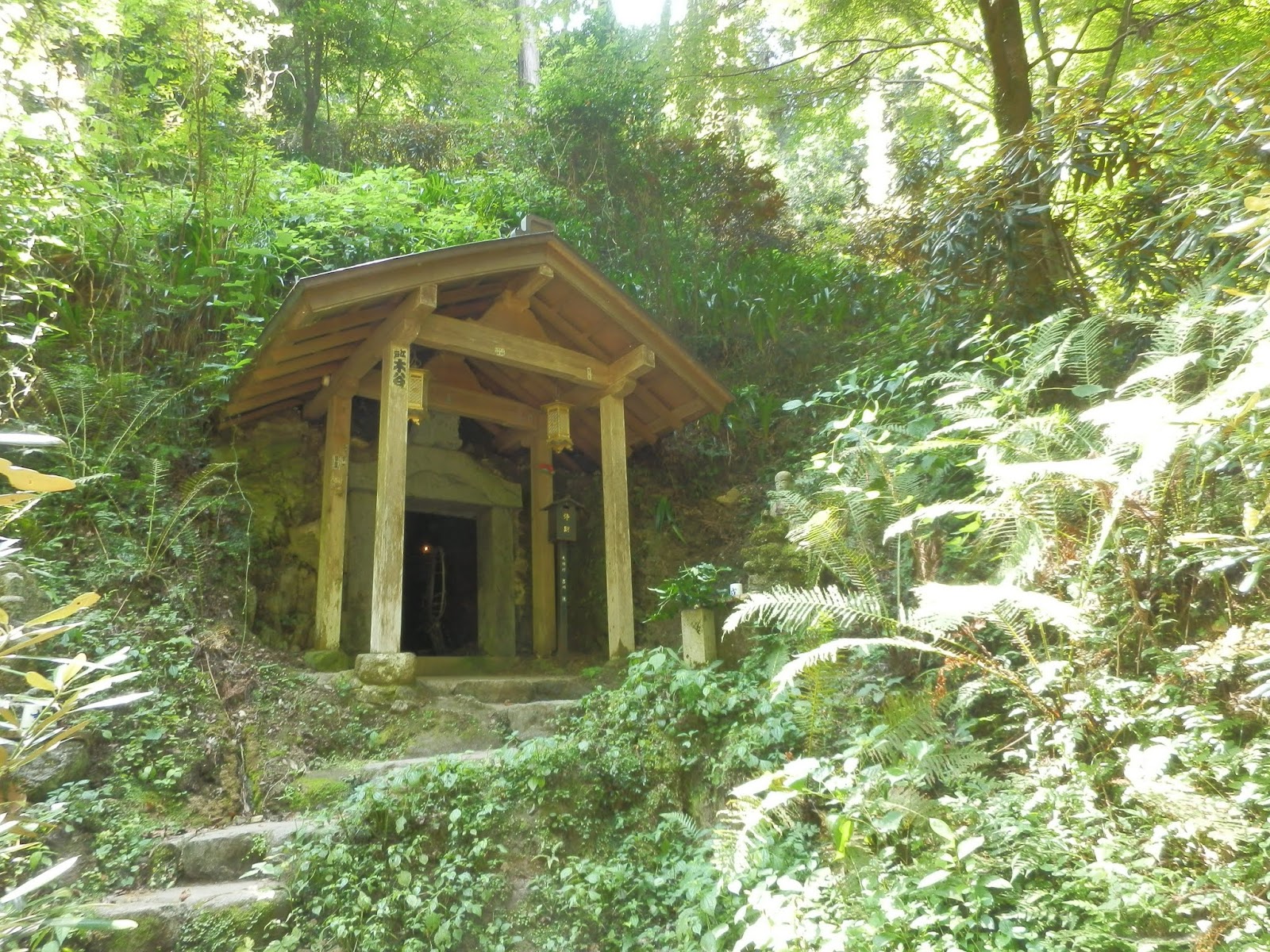
I took my time exploring around a bit, eventually coming to the Okunoin further up the hill. That’s the inner sanctuary, which is often tucked away somewhere further up the mountain. This one was a little cave which went back into the earth rather farther than I expected from looking at the front of it. There’s a small statue inside of the Buddha of the future, and an older couple who was praying in there ahead of me (I waited til they finished because there was actually not enough room for more than two people side by side in front of it, plus I always feel awkward when those I regard to be the ‘legit Buddhists on legit business’ are doing their thing and I’m just wandering around spectating) gave me a piece of tarp to sit on because the cave was damp and puddle-y. After sitting inside a little while, I stood up and noted how the cave at that point was just barely tall enough to accommodate my height, though I couldn’t walk upright through the cave. Then I noticed just just above my head a pair of the biggest effing camelback crickets I have ever seen, and I crouched right the hell back down, packed up my piece of tarp, and with one more bow, hurried back out into the light.

Entrance to the cave...
So, yep, bugs and mountain-garden foresty earthiness. It was a beautiful place and I’m glad I got to go in the morning when it was so quiet and peaceful.

I next caught another bus to a tiny train station (Asuka), from which I was to proceed by train to another train station (Tsubosaka-yama) and wait for a more different bus, which would not come until 1:15, although I had to get on the first of these buses at 11:06. This meant I would have time for lunch in the train station area, and here is where I made a Saiou’s Horse kind of mistake.

Asuka station was flanked by your usual handful of little restaurant places, none of which looked particularly good, so I decided to eat in the area of the second station. Getting off the train in that area, I looked around, noted it to be a touristy-looking street ahead of me, and decided to wander til I found something, since I had nearly two hours to kill. The sign above the road said that the town was one of “sightseeing and medicine,” which I thought odd, but shrugged off and began to walk with my little parasol overhead. I wandered in a sort of loop for twenty minutes or more, finding that every single likely looking place I came upon was not a restaurant, but instead a hair salon, dentist, or other treatment facility, and half were closed. There had been one well-marked restaurant just by the station, but the sign on the door said “closed today.” Ah the perils of traveling on quiet weekday afternoons.

Oh why are you closed...?
I returned to the station along a sweaty, perilous highway with a tiny sidewalk and asked the station guy about food. He pointed to the tiny closed place and I protested its closedness. He shrugged sadly saying, that was it. I sat down on a bench to reconsider. This was crazy. Not eating was unacceptable; I would have to find a combini or something.

It was then I remembered that I do have a smartphone and it is good for more than just email and mapping exactly where I am. It also has a ‘find restaurants in my area’ function, of course. I put it to the test. The first listing was for a place half a kilometer away, not so bad, and a ten minute walk according to the review written in Japanese. The place was just past where I’d come upon the perilous, sweaty highway, and I did not relish taking that walk only to find the place ALSO CLOSED, so I did the thing I always dread doing, prepared myself for Japanese and phoned the place. I was about to give up hope when an animated voice answered pretty late in the ringing cycle, confirmed that they were open, and that it was a ten minute walk from the station. I needed no more than that, and set off.

The place was across from a combini, and I briefly considered grabbing some quick food there instead, because now I was beginning to worry I wouldn’t be back at the station in time to catch the bus at 1:15 if I had heard right and the restaurant I was headed for would take some time in food preparation. But I thought I saw a bus stop sign just a little further ahead and felt sure it must be on the route I wanted, right? And if it all went to hell I’d just call a taxi and catch up with my schedule later.

I then stepped into the restaurant and had the best damn udon I’ve ever eaten, and I’ve been to Shikoku AND I don’t even like udon, but I was supremely glad I hadn’t given up and gone to Lawson’s. The lone guy running the place was apparently making the stuff from scratch, and it was a beautiful thing. If you are ever in the western end of I-think-I’m-lost Nara prefecture, I give it a thumbs up.


My food was ready in about perfect time for me to eat it, pay, and get to the bus stop which was in fact the bus I wanted, which took my up the winding paths to Tsubosaka-dera. Tsubosaka-dera was, once again, totally different from the other temples I had been to so far, especially in its palpable connection to India and Indian Buddhism. Without really solidifying in my head what that image is, I have formed an idea of what a Japanese Buddhist temple looks like, but Tsubosaka-dera does not look like that. The imagery was different, the atmosphere followed suit.


This temple is connected especially with sight and eyes, not only in the prayer sense, but also in the very real sense that there is a home for the blind on the premises. The connection to India is in their ongoing support of programs in India. This temple therefore felt like a museum in some ways (I mean, there was a wall, a relief carved wall with stories from Buddha’s life!), but also like a functioning thing, not a relic. 

This statue is related to a legend associated with the temple about a man healed of his blindness.
Maybe because it was a weekday afternoon and tucked far away up on this mountain, but there were hardly any other visitors that I could see. I walked around a little and made my way to the main hall, where I slipped in quietly and looked around. The main statue here is also visible to those in the hall at all times, this one because it is meant to be seen, in connection with its healing for sight issues. Just as I was about to head out and explore the grounds some more, a large group of older-ish Japanese folks had massed at the entrance, looked like they had come by big tour bus, and were being given a short lively speech by the guy I’d nodded to solemnly on my way in. I passed the merry crowd and walked again through an area that made me think someone was burning lavender incense until I realized I was surrounded by lavender plants being baked in the sun.


Made in India, actually, then shipped over and reassembled in Japan.
I checked out the great Kannon, and reclining Buddha, and inspected the building that is covered with tiles made to imitate the ancient tile found in the area, and tried some of the eye-healing tea. I knelt on the power stone, and asked for clearer sight, to which I swear I heard Kannon-sama chuckle and say, get lasik, you.


The last bus out was at 3pm, which I at the time thought a bit strict, but found to be perfectly timed for me that day. I bought a bottle of Tsubosaka spring water and beat it toward Hasedera. The final walk to my ryokan for the night was pretty sweaty, given that I was wearing a backpack and walking for over a kilometer even if it was through cute streets (the kind that lead the way to important temples or shrines that get a lot of visitors… these kinds of streets develop with gift shops and inns and restaurants to serve the travelers, even from really old times). It was just after the heat of the day and I was beat.

I took this before she brought the soup out even.
I was the only guest that night at Yoshinokan, so I had a little tatami room all to myself. I bathed, put on the provided yukata, and ate my fancy Japanese dinner while watching the Olympics with the proprietess. Then I took a little walk up to Hasedera’s steps and back along the small river. I thought maybe it was kind of neat to have walked up to temple number eight on August 8th, even if I wouldn’t really go in til the following day. Nami-san had set me up to stay the night basically at the temple doorstep so  I could attend the morning prayer service which is open to the public.

Once darkness had fallen, I retired to my room and happily conked out at about 8pm (perfect for a 5:45 wakeup, if you ask me!).

Friday, July 13, 2012

Both Ways

It's Friday the 13th, and we return to cookie baking. I told myself, we're gonna do this again, and we're gonna do it right this time.

Planning well in advance, I got my wonderful parental units to supply me with a shit-tonne of the instant pudding necessary to make the cookies. The also brought along some chocolate chips to make my ordering load lighter.

I can't believe we're making them today. Not because it's Friday the 13th, but because this week has been so incredibly intense and it's only been like four days long.

I want to do a 'real' post about this.. complete with pictures and all that, but for now I'll just fill in the outline.

Last weekend was a sort of mess. Friday, I didn't go to work, but instead to Kobe where I was made an official Goodwill Envoy of Hyogo Prefecture. This just means that wherever I go I should spread the good word. This is easy; I'm liable to pimp out anything I think is truly any good (someone once told me I would be a good saleswoman when I vehemently extolled the virtues of some thing or other.. but the truth is I can only sell something I really know and love).

So that just meant no school that day. Saturday was supposed to be a school day, sort of.. we were to go to work and then after an hour of hanging out at school, go and watch kids compete all over town in various taikai things against the other schools (then get Monday off as a trade in day). But Saturday got rained out so hard they called in an O-ame (too much damn rain) warning, which cancels school in the city. (This happens way more than o-yuki, or too much snow warnings, actually... seriously, imagine a place where rain cancels school more often than snow does!)

So Saturday got pushed to Sunday, and we still had Monday off... I had a visitor in town to hang out and see the taikai, and we thought go to the beach Sunday, but no cigar.

Long story short, it was planned to be a sort of schedually challenged weekend and became EVEN MORE SO because of the rain.

This thrust me into Tuesday's 'last lessons day' at Small Elementary with little mental preparation (since I had Monday off and work on Sunday? I don't know). And then suddenly everything was happening at once. Tuesday was an exhausting run of six class periods conducted for all grade levels, including kindergarten, made heavy with the knowledge that it was the last one for each and all of them. By the end of the day I was a ragged mess. Wednesday was first-year classes back at the middle school (Mario Kart game ftw), and Thursday was the actual last day at the bigger elementary school, which left me less wrecked by still glad I wore waterproof mascara.

I felt better at the bigger school because they made a bigger deal of things.. I felt okay about crying because I could tell they wanted me to cry. They were doing things with the express purpose of making me cry. Then the entire school "hana-michi" style harassed me all the way to the front door. It was exhilarating, and exhausting. More about all that later when I get the photos ready.

In an oddly fitting gesture from the universe, the little girl who walked into the office on perhaps my first day (she was a second grader then) was in the office again during the end of my last day. She was the first student I have memory of speaking directly to; as a second grader she came up to me and told me that I was cute (which was a shocking thing to hear from an adorable second grade girl willing to walk right up to you), and gave a sort of botched self-intro in English. She's one of the special needs kids and is absolutely precious still. She's a fifth grader now and she thanked me for the time I've spent there before I slipped out to put all the presents I'd gotten near my desk at the middle school.

And since I realized (that afternoon) that I was going to be making cookies the very next day, I decided to just get all that stuff when I had my car, which I would on Friday, because I would need to transport said shit tonne of pudding mix (not heavy) and 5.5 kg of chocolate chips (kinda heavy) along with a few other odds, ends, and things.

So yeah. It's been a short week (too short... I almost wish I'd had Monday) and now I'm facing this weekend when I will rent that giant effing van I once drove, roadtrip to Shikoku with some of Shiso-plus-Alessandro, and go rafting and canyoning again. 

All that because it's a three-day weekend, which leads into another too-short (blasphemy, I know) week, which is the last week of this semester, the last week of my job in any actuality. Ending ceremony is the 20th, the day after our Salamander farewell dinner which is the same day as the BOE last 'greeting' for which I'll get out of school early (I am never sure these days whether skipping school time is a good thing anymore)... 

There is no time to think, little to plan, and I feel like I should have seen this coming, but I didn't realize it would come on so fast! I know there will be another quieter period once the school year ends (after my 'word' at the closing ceremony, etc.) for me to pack and clean and sort, but the way all this descended in a rush makes me feel like I should be packed and ready to go, like, tomorrow. Which just adds to the sense that there was probably a time to think and feel and plan, and that time has come and gone while I was marveling at June and how for the first time it wasn't a shit show. Whatever was missing from June has about hit the fan and here we are up on the final countdown.

So some moments I'm really happy, and some moments I'm hearing a song I just discovered on a CD I unearthed in the packing process and it's making me cry. And some moments I'm feeling relieved that I don't have to plan for/worry about/English educate this or that group anymore -- that their enthusiasm for or knowledge of English is no longer my responsibility. Other moments a particular face will come to mind.. a kid or a teacher, and I'll have to forget for the moment how much it sucks to leave a place.. how much I always did hate graduations.

One of the third graders summed it up pretty well at my send-off ceremony. "She's crying! Look! Now she's smiling. [confusion]" There's that saying, don't cry because it's over, smile because it happened. But I was always one to have it both ways.

Wednesday, March 7, 2012

Laos

I just realized I never posted about Laos!

Don't worry, it's not an epic seven-post series like Cambodia. The Laos part was a lot more vacation-y and a little less life-altering. Our group was smaller, and we were a bit worn out from the first week of travel, so we took it fairly easy, just enjoying our little hotel in Luang Prabang.

The Laos trip is a tale of two cities, first the World Heritage City of Luang Prabang, and second, the capital of Vientiane.Luang Prabang is a tourist site, altogether, but it is also incredibly pleasant. Vientiane is a living, moving city, so it's more dynamic and also noisier.

Let's talk about Luang Prabang first.

Hotel room!


My memorable impressions of Laos are mostly of sensory enjoyments, sleeping in, food (oh goodness, the sticky rice thing we ate in Luang Prabang that I spent the rest of our Laos time tracking down and eating at every restaurant possible), biking liesurely, "Tuk-tuk, waterfall?", and the way the market was so very different from that in Siem Reap.

Night market!
 Seriously, we went to the night market and the people would watch you walk by and just say hi to you, unless you stood there staring at something, then they might offer to show it to you. You were not accosted. I think we saw even more orange-robed monks in Laos than in Cambodia.

I thought this image was so cool (this photo taken at a temple). I later bought it in print form at the night market.

A tale of a like three? dollar foot massage.


It is as peaceful and sun-dappled as it looks.
 
Down by the river behind the hotel

The "bamboo bridge" .. quickest way to get into town from where we were staying. But only on foot.

When biking, take this bridge. Think about how cars have to go to cross this. One direction at a time.
Miriam left us not long after we hit the second city, Vientiane. We had signed up for a bike tour of the city on the 5th, our second day, but the morning was rainy and chilly. It got pushed back to the afternoon, but Kameron was feeling sick, so I went without him.

Our bike tour leaders are totally Dutch. 
Tank treads make good fencing

F-you, Thailand across the river!


The bike tour was a really good way to see the city, and I enjoyed it more than the walking around and self-guided sightseeing I dragged Kam along for on the following day. Memories of Vientiane are the bike tour, and the nightly movie on the movie channel in the hotel room.

Oh, and finding food on the last night, which led us around the area where our hotel was. We're far enough from downtown that it was a bit of a pain in the ass to go all the way there for dinner. But the places around us didn't have English menus (we walked to one and walked sadly away). The second place we stopped at didn't look too promising, but the guy seemed willing to communicate. Then he read my shirt. Which was in kanji.

Turned out, he had stayed in Japan and could speak Japanese rather well. We did all our food transaction in Japanese. Then he told us about how the movie Tokyo Drift is totally about him, so we took photos with him. I haven't seen that movie yet, but I now plan to, and when I do, I'll think of this guy.


Friday, February 24, 2012


Emily, it’s been so long since you updated! What have you been doing that is so absorbing?

A whole lot of not much to write home about.

Well. Let me tell you what. At work, as things continue apace, rocketing toward graduation, I finally took all my marbles in hand and chucked them in the river (so you can’t call them ‘lost,’ exactly..). Idecided it was high time I tried the old ‘cooking class’ with middle schoolers. I also decided that, instead of some kind of culminating lesson with the younger elementary students, we’re just going to do a ‘cultural’ lesson for the end of the year instead (see: play foursquare and HORSE in the gym). This is essentially my way of giving up on teaching 4th graders anything but the alphabet, God love ‘em.

As for the cooking, I have chosen my favorite recipe perhaps of all time, the delicious cookies I have been making since perhaps I myself was in middle school, recipe received from childhood friend Cindy. I thought of them because once, in high school, a few friends and I made a huge mess of them (like the way you might make a ‘mess of biscuits’ with Pappy O’Daniel flour) in lieu of other Valentine’s Day activity, then went about the school dispensing them in decorative baggies to our favorite people.

The problem with them is they require special ingredients not found in Japan, specifically instant pudding mix and chocolate chips. And I know certain Japan-familiar friends are going to give me shit about chocolate chips, because you can get them at Jusco, so let me qualify that by saying I went to Jusco and the chocolate chips there are MINI chips and they come in MINI bags, and are not appropriate for this LARGER THAN LIFE recipe of deliciousness.

So I sent away for some chips from Foreign Buyer’s Club (along with some oatmeal, taco mix, and other wonderful things, although I yesterday rediscovered a box of Reese’s cereal in my pantry I had forgotten I hid there.. basically I mean to say, I’m hitting the food jackpot)and found myself wondering why I haven’t ordered anything from them ever before, or in fact why I go to the grocery store at all, excepting the fact that I don’t think it’s a good idea to ship eggs to me, and also that bread comes in packs of about 3 slices, so you run out of that pretty fast (which is actually a good thing, because it goes bad just as fast), when ordering stuff online is so very easy.

Because, why leave your house at all? Well, actually I’ve not spent as much time there as I had expected to. I’ve been writing, actually. That novel I keep going on about (do I?), I’ve actually started working on it again and have completed a lot more words. But before you say “send me the first bit,” halt, you who are ignorant in the ways of “NaNoWriMo” and other such ‘just-write-that-shit’ techniques, because the first bit is total tripe right now, because I’m just trying to push through to get any possible amount of the plot barfed through the keyboard into word documents, so it calls for massive revision, especially because on some days, I didn’t feel like writing ‘description’ of any kind, and those happened to be the days that certain scenes were set specifically so that I could describe the setting of the fantasy world as seen through the eyes of a visitor. So that section goes kind of like “There was a parade. It was colorful.” The end.

I got the best comment EVER from a first grader yesterday at go-home-kai. I’ve been swimming a few times a week, just to stay moving, and especially on the Thursdays where I have to skip kempo for evening English class (I just bring a bag and my car and spend the entire day up near work because the pool is right next to work, actually). So it was Thursday, and the week before, I’d been at the pool, so this little first grader said “You’ll be at the pool today, won’t you.” And I said, noooo, actually today I have shorinji kempo instead.

And that cute little kid’s eyes bugged out of his head and he cried out "Suge~ onna!" And I laughed right out loud, because “sugoi” is a word that means .. “awesome” or “incredible, terrific, impressive.” But sugei is the Kansai version, and truncating it is a way of intensifying the word to sort of import shock into that impression. Onna means woman, but is not the politest thing to say.. normally you say onna no hito, meaning female person, for woman. So overall it was pretty much an intense, very Kansai, rather rude, very flattering interpretation of me. The kid then went on to tell the kid next to him that I was scary and one should not mess with me. 

It was pretty much the highlight of the month.

Otherwise, things just keep on keeping on. Lots of changes on that horizon, lots to come. Keep feeling like the end is nigh (and it is, with graduation upon us as of the 9th), the end is nigh, but there's a lot to go between here and there. And beyond!