Showing posts with label festival. Show all posts

Wednesday, January 11, 2012

The Village

Once we’d made our way through visa adventures (we were last in line for some reason) and changed some money in the tiny Siem Reap airport, we were met outside by a guy holding a sign emblazoned with the PEPY logo and our names. This was Yut, our guide for most of the trip. We made a quick round of introductions, and he led us to a van. I was pretty loopy from the whole getting up at 4am (3am, Cambodia time!) thing, and it was now about 8:30.


  Yut explained that we were going to head to the village homestay straightaway, with a stop along the way to visit a silk-making place. He passed us some snacks (one bag was full of chips and things, the jackfruit chips being my favorite, and the other bag was full of assorted fruit like tiny bananas, lychees, mangosteen, and other things too exotic to be within my memory grasp), and then we were seeing how silk was made, both old and new methods of spinning, dyeing, weaving, and so on. Cambodian silk is always a yellow color before dyeing. We got to hold silkworms!


Next, we stopped for lunch; Yut said it was an early lunch, but to me it felt like about the right timing.. we’d been up for a whole day’s worth of time, and it was throwing me off. Yut casually explained what kind of ice is okay to have in your glass (round cylinders with holes are okay, but stuff that looks like it was maybe hammered off a big ol’ block is not so good) and ordered us a round of freaking delicious soup and other food.

We progressed on the road to Banteay Chmar, which is northwest of Siem Reap, near the Thailand border, stopping once for gas (and fried banana chips sprinkled with a dusting of sugar). Spent most of that time just staring out the window at the landscape. Miles and miles of houses on stilts, muddy large-puddles or mini-ponds filled with ducks by the roadside, large expanses of now-dry Riceland populated with wandering cows.

At Banteay Chmar, we settled our stuff in our homestay locations, two houses across the street from one another, and regrouped at the town’s local center for tourism and international things, which we came to consider our base or clubhouse, as we often met and ate there.

We had our first language lesson with Yut, who had taught us some Khmai (Khmer) in the van (we had immediately wanted to know how to say things like hello and thank you). Being a whole team of language teachers, we practiced it on each other. Then we took a walking tour to one of the small temples that is part of a set of eight that surround the big temple of Banteay Chmar. A group of cows made way for us and we learned about the four-faces style of the Cambodia temples from our locally (as in Banteay Chmar) based guide, and from Yut (who is from just outside Siem Reap).


Studying!


We walked back through the village saying hello and taking in sights as we headed toward dinner at our clubhouse. Over dinner, we discussed an article we’d been asked to read about the recent flooding in Cambodia. The big lake between Siem Reap and Phnom Penh, Tonle Sap, grows and shrinks with the rainy and dry seasons (that is why houses are often built off the ground level), but this year the rainy season brought flooding more extensive and intense than in years before (read about it here).

After dinner, we were all pretty tired. We returned to our homestays where I washed up with the ladle and resovoir of rainwater in the tiled bathroom while Kameron, Katie, and Miriam practiced Khmai with our host family in the ground-floor living room. We then went upstairs to bed under mosquito nets in little wooden rooms with the shutters open. Our local guide had explained we can shut the windows when we get cold, and we’d laughed, but that night the wind made things pretty chilly and we ended up taking his advice.

Being in the village was like hitting the opposite of everything I had been sunk in even just the day before, in our plush hotel in downtown KL with room service breakfasts and shopping malls across the park at KLCC. I felt, in Banteay Chmar, farther away than I had ever, ever been from everything I had ever known. Our homestay house was a rich one, I knew, because they had a TV and it was on in the evening when we came back. Across the street there was parked a Toyota Camry. There wasn’t running water, so you flushed the toilet by pouring water in with a ladle-scoop. The roads were dirt, and incredibly dusty in this dry season.


That's the front door; our rental van at right.
 Kids ran around both shoed and barefoot, chickens seemed to be living the free-range life. Everything seemed much more raw and vivid, like the terrifying idea of living hand-to-mouth, only for real out here, not through some conduit of paychecks and well-lit open-late grocery stores. There were no grocery stores, nor things that required 24-hour refrigeration because the electricity turned off at night. That’s why (I conjecture, anyway) Cambodian coffee is served with condensed milk (and fresh milk is more a sign of luxury). Trash just littered the streets near the front of the market area, old, part of the ground almost.

Charging batteries for nighttime use.
The children were curious, the people were all very friendly. They were poor, of course, but there was something else. We, from America, New Zealand, and Canada, could make comparisons and think of what they lacked, but did they even know? And if you have never had a thing, can you miss it, can you long for it?

It was sort of.. swallowing. Certainly perspective-lending, which I will say I found myself in perfectly fitting need of right at that time. Beneath the Cambodian winter sun, standing on the dust and watching the dogs wander and people go by on trucks piled high, on bikes seating two or three, on long-horned automotive creatures, it really could not matter about this or that or all those other things I had already forgotten as soon as we got out of the van. The world is so, so much bigger, with so so many more problems, issues, opportunities, and things to understand than we can possibly know.

 Outside our bedroom window lived an extremely loud goose. Even without the goose, though, we were wakened early by a loudspeaker somewhere blasting music and sounding like a morning radio show (was that the weather in Khmai?) or something. I drowsed through it with my mad combination of sleeping-near-a-highway skills and earplugs until about dawn, when we all rolled out and back to the clubhouse to get ready for this second day in the village.

In the morning we went through the market, full of goods (someone tell me why Angry Birds are all over Southeast Asia?) and another part with food, buckets of still-flopping snake-headed fish, women shooing flies off of cuts of meat, lots of fruit and vegetables. Everyone who smiled at you when you said hello, or smiled at them, or sometimes for no reason at all. Little kids shouting hello in English.

I didn’t take any photos because I felt self-conscious about it, and because once we reached the end of the market and turned around, something was happening on one side. A woman was shouting at a man. I happened to be walking near Yut, so I asked him what was going on. “Domestic violence,” he said as we edged past the couple. I blinked. The woman had a meat cleaver. No way. “She’s very angry, he’s drunk.” Yut added.

In the rainy season, people have to work hard and fast to plant rice and get everything taken care of in time, but once it gets dry and wintery, people can relax more. It’s the harvest, and wedding season too. Our bike ride through the area had us end up near a place where day one of a wedding was to be held later that day. The preparation, a grooming ritual about cutting hair and making yourself ready to wed, I think.. there are seven days in a usual wedding, and on this day the bride and groom would wear red. We decided to go back to it after lunch instead of going straight to the old temple.

We visited another silk weaving place, and this time I bought a few things. We had another delicious lunch and learned some more Khmai (counting!), read some articles and had a nap before heading back to the wedding.


The goddesses are at far left and right
The wedding was strange to me, not for the customs but for the way we were treated. We were given seats and included like what I would call guests of honor, even though we were foreign strangers. I felt like we were gatecrashing a family event, but I heard later that they felt really honored that we came to that part of the wedding, graced it with our curious presences, I suppose. I wasn’t sure how to feel about that exactly. The wedding’s leader/holy man/emcee was really cool, and a pair of other people did a skit about goddesses coming to earth. It sounded like there was wordplay going on, and one of the goddesses was a guy dressed up in makeup, but all in all it was very cool. Lots of bright colors and music, and kids running around, playing games where if you win you get to hit each other.

From there, we headed to the temple, where we climbed all over. I’m used to sites where you can’t really touch anything, but this was a whole other place. We learned a bit about the naval battle and the fromage trees that are destroying temples everywhere (even if you cut them down, they come up somewhere else from the same root system, I think?). A boy from town followed us around, I guess to practice English.


Naval battle!

Fromage trees


As evening fell, we returned to homestay to clean up, another bracing rainwater bath, then we had our picnic dinner. We went back to the temple ruins and sat under the stars (there are a LOT of stars out there) by candle and torchlight while musicans played traditional instruments and had our dinner. A group of French tourists sat nearby, but I think we were having more fun than they were. After we finished eating, we got up and were taught traditional dances around a torch; we laughed and flailed. It was one of the magical moments of the trip, for me. Simon taught us the Maori haka, and we thanked the musicians and the cooks from the clubhouse and our local guide, because we were to leave the next morning.


The village stay, since it was so very far from everything, everything, is one of the most significant parts of the trip to me. I think I may still be working it all out.. something about living simply, about needing and wanting, about work or freedom or… something.

Katie with Tupaco

View from our homestay upper porch
More photos from this part here.

Thursday, September 22, 2011

The Ponderous Return of The Uj (as in "usual")

Well, I must apologize for leaving you so long with that bad taste in your mouth of me being a little bit of an asshole. The truth is, I only felt bad about it for a short while, because things just got too busy to carry on with all that!

That weekend that was supposed to be International Picnic but was typhoon instead (9/3-4) preceded our seven days of working-not-working, or Sports Day Week.

Since I had been complaining about needing a vacation, I tried to look at the daylong stand-around-outside fest as a forced vacation. It worked for a while anyway. The first few days after the typhoon was finished were almost cool, and they were clear and pleasantly bright. I stood under the blue sky, looked up through the cherry trees, and wandered amongst the students, all gathered for practice. Really, it was blissful.

And although I don't necessarily like to spend all day at my desk, I don't necessarily like to spend no time here either. I have a lot of stuff I do (I might have menioned before), things that require a bit of attention, if not daily, then at least every few days to keep them moving smoothly through the internet and my brain. Hyogo Times and JETinfogather are two big ones, but my kanji review list begins to get out of hand after too long, and there's always that TEFL course I just signed up for...

And it slowly becomes maddening to spend so much time each day doing actually nothing when you know there's stuff to be done. But by the time you get home, you're pretty worn out from all that standing around in the sun, so all you really want is a shower and a nap and maybe some dinner.

So it's the best of weeks, and it's the worst of weeks, and it's also longer than most weeks, since you spend Monday to Saturay in practice and prep, and then the Sports Festival itself is Sunday.

All of our favorite events were back, the dancing, the family races, the relays, the mukade (centipede) race (I don't know whose idea this race was, but it's hilariously full of wipeouts)... the log-pull, the hat chicken fights without a pool (also called kibasen, or "mock cavalry battle")

Sports Day itself was pretty hot, with a little douse of rain in the morning to wet down the field and make the relay race a bit tougher. I got my new camera replaced for free (the rice-bin one never did recover, but the store exchanged them for me, no questions asked.. must have been under some kind of warranty since I did only buy the thing a few weeks before it got typhoon'd) so I was holding down the shutter to take a lot of rapid action shots.

Got to see a few of the graduated students, including a couple favorites..

The PTA enkai that followed was not far from the school. At first I sighed and thought, oh, I guess I have to go, but then I remembered that I love meeting kids' parents and seeing where they came from in that respect, so I was even happier that I had the good fortune of being seated next to, across from, and diagonal to parents of a couple of my favorite students. It only makes sense, of course, that the PTA parents have the mroe involved, harder-trying kids. Best of all was that the guy to my right was my speech boy's dad.

A teacher at Higashi asked me who our speech kids were, and when I said this kid, he was like "Aw crap."

All in all, it was perhaps the most successful sports day yet. I cannot find the memory card with the photos from that day, so I'll put them up eventually.

 Following our Monday-Tuesday fake weekend (blissful, that), we had a three-day work week, which for me was chock full of the usual. Classes, commitments, planning. It went off without any more hitches than usual, anyway. Since my 17th - 19th hopes for pilgriming had been rained out, we had to devise a new plan...

That entry coming soon.

Saturday, June 4, 2011

Omizutori

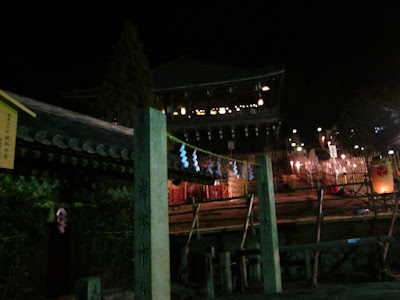
Omizutori is a famous event at Nara's Nigatsudo. My visit to this event has its roots in the first time I visited Nara, on Christmas 2010; our guide Osaki-san pointed out the blackening around the wooden rafters of Nigatsu-do.

お水取り, Omizutori, quite literally is the drawing forth (tori) of water (mizu), but the most famous and pictorally represented aspect of this yearly festival is the part where stuff is on fire (which is actually called Otaimatsu). Priests walk huge flaming torches back and forth along the porch of Nigatsu-do and shake them in certain places. If you have sparks fall on you, it's supposed to be good luck.

Different combinations of the spectacular event happen on different days, but the 12th presents 11 torches instead of 10, and visitors are circulated through by the crowd control machine that is the Japanese Way. Other nights, you just have to get there early and camp out if you want to see anything. The 12th is also the night of the "mysterious" water-drawing ritual, or actual Omizutori. Which happens at about 2am, making it a lot less accessible (trains don't run after about midnight, so you are walking or taking cabs from that time on.. and you better be staying the night in Nara, for this). I decided that I wanted to see it this year, because I was never going to travel all the way to Nara on a school night and stay up til 2, and this year, the 12th of March fell on a Saturday.

Nigatsu-do is part of Nara's iconic Todai-ji, home of the huge Buddha. 二月堂, Nigatsu-do is literally the hall (do) of the second month (nigatsu). And before you say, well then why do they have all their special events in March (三月), allow me to introduce myself: Hi, I'm Emily, and I'm obsessed with calendars.
HI!


I discovered this preoccupation most solidly when I chose the fasti as my topic for study and presentation in the ICCS Rome program (I just went looking for that photo and saw some rad photos which make me amazed again that I got to go to that program!), but here in Japan, it just means that the New Year's gift of a horoscope calendar book (given by one of my adult students) was very well placed. To make a short story long, the old Japanese calendar had 1/1 this year on our Gregorian February 3rd, so the old calendar's "second month" would actually be happening in the modernly conceived "third month," and so on. (If you care about this as much as I do, check out the wiki page on it too.)

So Nigatsu-do is pretty much named after its biggest event, the March drawing of mystical water. The water actually comes out of an unassuming-looking building at the bottom of the steps leading up to the hall.

You can see the well house at the bottom of the steps, to the right.
From 2010_12_25

And of course I was going to see that. Flash and fire and accessibility may seem awesome, but quiet mystical water is more my bag. Who needs trains? I'll walk across the city, my 10am wakeup be damned.

Now as you may already be mentally protesting to your silly blogging author, the 12th of March this year also happened to fall on the day after the 11th of March, which would be the day that a massive earthquake and tsunami completely tore apart the north-eastern part of the country. And I went to Omizutori anyway. I don't have much to say for that, other than there didn't seem to be much reason to cancel the plans. My traveling companion and I saw the last few torches, I took some grainy video, and then we put on every last layer we could find, and settled in to wait.

Spent some of that time exploring the area around Nigatsu-do, got a calligraphy page (as mentioned in the pilgrimage post), managed to get in to one of the small rooms around the outer wall of the hall, where we could hear the priests chanting and clattering around in their wooden clogs inside, and could see only the glow of maybe candles through the slats. The chanting was hypnotic. We meditated, we sat. It was cold. We had some sweet bean mochi and tea at a little shop that was staying open all night. Then we went down and camped in a spot right next to the door of the well house.

View from our sweet standing space, before the lights were turned out.
From 2011_03_12

Part of the reason Otaimatsu is more photographed is that the actual Omizutori prohibits flash, and is very very dimly lit. They extinguish all the electric lights and proceed by torch up and down the steps, drawing the water and carrying it up to the hall, in all three times. 

I took some video, partly because the lighting prevented any but the blurriest photos, and partly because I wanted to get the unearthly droning of the musical accompaniment. If you click through here, it'll only take you to the album associated with the post-midnight stuff. For pre-midnight, click the photo up above.

By the time they were finished drawing the water, it was way too cold and I was not Buddhist enough to attend the Dattan part of it, especially because I thought it would be a lot like the earlier meditation time, and we would need special badges to get in, which we did not have (and which we had not needed previously only because one of the door guys took pity on our idiocy). So we grabbed a cab back to the hotel and hostel area.

I assumed the following day would be a too-tired-to-enjoy wash, but it was actually really nice. We walked around Nara, checked out some lovely park areas, skipped a museum, and enjoyed the sunshine until it was time for dinner (Vietnamese!).

Sunday, May 15, 2011

Happy Monday

Monday, May 9th, was like some kind of anomaly in the world of Mondays.

I had the day off because it was my school's "Foundation Day," which fortuitously came at the end of the Okinawa trip. If I had known about the day off in advance, I might have tried to extend my stay in Okinawa yet longer, but as we have seen, that would have been a not so good idea. So, instead, I just had an extra day to recover from vacation before heading back to work.

Monday was dazzlingly sunny and quite warm. These are perfect laundry conditions. In the winter, laundry takes about a full day in the sun to dry. More often than not, it would end up hanging from my closet door while I ran the heater at night. One thing I like about spring and summer (rainy season excluded) is the way you can hang laundry out more frequently, with much faster results.

So I did some laundry, and I finished unpacking, and I made a foray into the garden which had somehow lost all its color (other than greeeeen) during my absence. And there I discovered 8.6 zillion motherfucking aphids on each cluster of leaves on my little plum tree. Any kind of insect, especially large numbers of very small ones, which is eating something in my garden makes me really, really, irrationally angry. I want nothing more in the world than to end their lives as quickly as possible. Because how dare those little bastards be destroying my poor innocent plants that are not hurting anyone and that are tenuously enough holding on to life as it is? The little flowers and trees out there are just tryin' to grow, and they are bright and a beauty and a joy and anything that brings harm to them must instantly cease to do so, or die.


From 2011_04_30


This murderous rage was the only blot of negative energy on the whole morning. The rest was spent relishing my plan to visit the Thousand-Year Fuji (wisteria) of Yamasaki. I decided to go and see it on a general foray into town by bike, the usual, bank (what's the damage, Okinawa?), post office (packages to pick up, letters to send). Osaki-san had said the best days of the fuji blooms were usually right through Golden Week (3rd - 5th of May), but I had resolved to go check it out as soon as I could get over there after getting back from Okinawa.

Of course, as with any season-dependent plant life, dates only give general ideas of when the best time will be. There are photos on display at the shrine by the sen-nen fuji showing it in full bloom on May 10th, and another year, April 28th. People come from far and wide to see this thousand-year fuji (recall our own pilgrimage to the thousand-year sakura tree in Yabu), from Osaka and maybe even beyond, so I figured I was pretty lucky since I could just bike a few blocks.

Last year, I went to see the place when it was just past its prime. I had heard of it, but didn't even know where the shrine was until it was too late! A few hangers-on wandered in the pleasant shade, and there was the mild scent of dried flowers, some of the fallen petals crunching softly underfoot.

From 2010_05_16

I went a few more times to that shrine just to poke around and enjoy it. I think of it (quite all made-up by me, I assure you) as the shrine to Japanese Venus, or sort of like that equivalent (femininity, growth, fertility, love, etc.), partly because I went there at a time when I was thinking about Venus and new beginnings and healing and growth, and partly because of this statue:

The shrine is called 大歳神社, or "Otoshi shrine" .. and it turns out that is more associated to Jupiter, than anything. 
From 2011_05_09


This year, as I rode up the hill to where I thought I should park my bike, the warm breeze wafted a lovely floral scent over me. I realized with a start that it was coming from the wisteria. I was prepared for the color, and the crowds of old people, but I had not thought about the way the place would smell (I, being lately rather sensitive to smells; recall how a whiff of the moldy smell in our condo made me queasy). I went into the main area to sit in the shade and breathe in the fresh gentle smell of it all. It was absolutely awesome. The photos don't do the warmth or smell any justice, but at least you can see some of the blooms (click through to go to the album):


From 2011_05_09


From 2011_05_09


From 2011_05_09


From 2011_05_09


I thought this was cool, the blooms coming out of this vine near the ground! The main trunk in the center of the pavilion did not have this.
From 2011_05_09


I also really liked the idea that I could go run my errands, then come back again and sit for a minute, if I liked. I resolved to do so, and also to stop at Osaki-san's "open garden" (she lives really close to the Sen-nen Fuji) and ask her advice on those gdmf aphids back home.

When I went to Osaki-san's, I didn't know what to really expect. What we had there was, older people, mostly ladies, wandering in in nice dress to take traditional matcha tea (complete with a sweet) in Osaki-san's beautifully appointed tea room, with a view to the garden. Then she walked through the garden with the lady I happened to sit next to and take tea with, and pointed out some stuff for both of us. Before I left, she gave me a nice big bottle of AphidDeath (named by me) to borrow, and also some riceballs, which I took back to the fuji to eat for lunch while basking in the ancient plant's sweet presence.

As I biked home, there were cars lined up all the way to the main road, and people walking along the street between the Michi-no-eki (road station) and fuji. There's really no parking up by the shrine. I felt even more pleased to be on a bike, and decided to visit the fuji every day for a little while, if I could (of course, this plan was foiled by three straight days of heavy rain, which also did their part to take out most of the blooms and leave the display in worse shape than I found it last year!).

I spent the early afternoon doing a bit of gardening, finishing up some chores, and getting ready for the evening. At 4pm I had my second HPV vaccine shot. The paperwork runaround eventually led me downstairs where a nurse with a "I'm new" badge on her nametag asked me which arm I preferred to take my painful injection in. Another nurse corrected her, showing her that it was already written on my form, that these things were all decided ahead of time. I thought, awesome, the last shot left my arm sore for two days. This is going to be hurt like a bitch and a half with sweet nurse Newbie stabbing me.

She was super sweet, though, and as she got ready to stick me (with all the seasoned nurses, including the one who got me last time, standing by in a line against the wall, watching), she said "It's going to hurt, so be brave!" I took a breath and tried not to remember how, when I was 13, a nurse had to try like five times to get the IV in my hand properly because she was new. But just because it was Happy Monday, maybe, the shot didn't even burn like the last one did, and the following day, the muscle was only a little sore (nothing like the time before!).

I hurried home to get ready for homemade okonomiyaki dinner at Heke's dance teacher's house, which was excellent, and of which there was too much food, of course. Wrapped up the night by going over trivia questions with Lester for the Pub Quiz at the end of the month. All in all, an excellent day.

Sunday, March 13, 2011

Saigai

I posted my last entry to the web at about the time a massive earthquake was shaking eastern Japan. A friend of mine who lives in Tokyo and I had been exchanging messages about plans for the upcoming three day weekend (I was trying to convince him to visit beautiful nature-filled Hyogo), and he added as a little addendum to one "Big ass earthquake just now btw" at 3:05 pm (my time). I hadn't felt anything and almost didn't give it much thought.


A little while later, I messaged a few friends in Yamasaki, to ask if they'd felt anything. My fear actually jumped to my apartment, because sometimes it's snowin' in Ichi and springlike in Yama. I hadn't cut off the gas supply to the water heater or anything and I wanted to make sure stuff wasn't going down at home.

I live in West Japan. The Kansai region was largely undisturbed, from what I heard.
But nobody had felt anything. I looked it up on google news, finding one article about a megaquake shaking Tokyo. But we were too far to feel that, and about halfway between the north and south coasts. Someone said the TV was on at their school, and not too long after, commotion started in mine. We turned on the TV.


It took a moment to realize what we were seeing. It was apparently a live helicopter feed. A corner figure of Japan flashed giant red patches over sections of the map. The teacher behind me said, "What is that, a river?" Not a river, the ocean, come too far in, and far too fast.

The aerial we were seeing happened at that point to be Sendai. Relentless water pushed fire and debris and boats and houses, sweeping across rice fields. I kept thinking something would stop the motion, slow the movement of the sweep, there, a river, when the water hits the river, it'll just go downriver and be a big river. But the tsunami that pushed houses into rivers pushed them right back out of those rivers the next second. It didn't stop, and didn't seem to slow down.


Teachers started texting family and friends, calling them on cell phones and asking in low serious voices if everything was alright. I guess it was.

All of this was right about my bus time, so I haplessly shoved my stuff into my bags and headed down to the bus stop, wondering what it all meant. I texted my Tokyo friend, and resisted texting my Okinawa acquaintance as I figured she'd be swamped with "Are you OK?" messages, since Okinawa was flashing all red (along with Hokkaido, and basically the entire eastern coast, and most southern coasts other than those protected, like us, by other large islands and peninsulae).

This is for the 12th, but it's the type of map we were seeing.

Then... we carried on as usual. We'd just had graduation, and we were worn out from that, everybody cried. I wanted a nap before the dinner/drinking party and got half of one before my co-teacher came to get me and take me to enkai. I wasn't sure how to be, what attitude to assume, whether to be quiet or solemn, but things were progressing as totally normal in my little town, so we ate chicken and soybeans and I got "a little bit whiskey" trying to keep up with the art teacher in drinking (I lost). We all gave speeches about how moving graduation had been, and then the party ended and everyone went home.

Or, rather, I went to karaoke to join the others who had just finished their enkai, and I was so whiskey by then I didn't order a single drink at karaoke. I sang loudly and pretty badly, and fielded worried text messages. We stopped for snacks at Gusto on the way home. Still a bit whiskey, I got online and posted to facebook again, just to let everyone know I really was still in touch, and then I went to bed at 2. Embarrassingly, it was a really fun weekend night.

People asked me to keep them updated, but I had nothing to report. Nothing changed in my town, nothing happened here this time (we had flash floods shortly after my arrival, but that was from a typhoon).

I'd had plans to go to Nara the following day for the Omizutori festival, which you can see a bit more about here and here.

I had no real reason to cancel those plans, especially since it seemed good to go to a religious festival in the very-old capital. The festival was still on, I had bookings at a hostel, and my traveling friend was still up for it. So we went, and it took forever to get to Nara (it just always does), and we hung around and attended the last bit of the fire part of the festival (saw the last torch or two), and then meditated in the hall and hung around until 2, when the sacred water was drawn, made it back to our respective overnight places by 3 (I counted seven pairs of shoes in the genkan, making me the last to return for the night) and went to sleep.

This morning, I got up a bit after 9 and went to have breakfast. There was a free piece of toast per person, along with coffee and tea. I had the odd status of being a lone traveler at this place, and I also talked to the proprietor in Japanese. I didn't really know he knew English until I heard someone else talk to him. It's literally the smallest hostel in Nara, and we were all in the common room, me getting breakfast, the proprietor sitting at the table watching TV, one (English? Australian?) guy doing sudoku at the table, and one guy sitting with headphones and a laptop on the floor by the TV. Another guy was in and out of the sleeping room where the computer also was.

The proprietor asked me about Omizutori and I answered in English. Then I couldn't stop staring at the TV. It's all they are talking about, of course, and showing. The map of Japan was still there and flashing yellow now. It took me a while to realize it meant that those areas were still under tsunami warning, "but just a little one," the hostel guy explained to me when I asked in surprise.

There were interviews with people (some who knew their families were safe, others who did not), pans of the wreckage, before and after shots, aerial footage from all over Japan, charts showing numbers by prefecture of the missing and the dead. It was horrifying. I was transfixed. The guy on the laptop burst out laughing, in his own little world and I wanted to kick him, then felt bad for being in my own little world just like that.

Because much like my readership, I didn't feel it, I only heard about it, I only worried about the people I knew or had met who lived in east Japan. I only saw what they showed on TV (which was unbelievably amazing in a terrible way). Then when I walked by the station, I threw my change into a box held by some high school students who had turned out in droves to chant please and thank you to passers-by. I saw a poster and made a mental note to give blood soon. Because in my mind, that's what it takes when disaster strikes, money and blood, and you give what you can of both. The other thing I hear we are giving is power. Kansai electric has asked people to be super conservative with electricity as we re-route some of our supply to the Tohoku region (the top part). I don't really know if everyone is okay. I don't know that knowing would help me.


On the bus home, I started thinking about what I could do. Part of me wanted to raise my hand and get on a bus (once they start organizing buses, as they likely will) to Tohoku to volunteer to help with cleanup the way high schools in Kobe sent their kids here to help haul away the mud and debris after our floods. Another part of me suggests that that kind of maneuver would not be in line with all the recent injunctions to stay safe.

Can you stay safe just by staying put? Apparently not entirely, not when the earth moves and the sea leaves its bed.

But what I did want to do was make a request to all my friends and family, to anyone who was glad to hear it wasn't Shiso and it wasn't me: please donate $2 to the Japan effort. You can do it any way you like.. I'm sure collections will be happening around you soon, and if not, collect some yourself and send it to me. I think the exchange right now is like 83 yen for a dollar, but I'll round every one to a hundred yen (they have direct deposit bank numbers on NHK, and you can give directly at kiosks in convenience stores). And give blood if you are eligible (this is always a need, but in times of any major disaster, the need increases). Thank you all who thought about me, and trust me, I'm just as glad as you that my evening was about graduation speeches and beer, not mud and broken beams.

I'll keep you updated, such as I can, but once again, what I know just comes from about the same sources as what you know. Stay safe, everyone.

Sunday, February 6, 2011

Denki carpet! ...and socks. Etc.

Here I sit, windows open on this grey Sunday afternoon, about 12 degrees in here, but I like the smell of the air enough to just wear a coat and double socks.

Socks have been my latest quest at the clothing store. Socks and carpets. I used to hate socks, as you might if you lived in a place where the best state of feet was bare, and socks just meant you were wearing shoes. But if your apartment isn't heated and your floors are made of tatami mat or linoleum-wood, well..

At some point in the past (Kansas) I had bought some long socks to reach above the knee. I kind of wish I had done this sooner; I might have been more comfortable in Tennessee had I not continued daily to venture out in thin or ankle-cut socks. Alas.

But my long socks are thin, and many of them are made of synthetic material. You might not think this is a big deal, and maybe it's not, but if your feet have to spend exactly all day long (excepting only the time you are darting to/standing in the shower) inside of socks, you might find that cotton socks make your feet sweat less, or breathe better, or something. So I developed the habit of wearing double socks (along with the rest of my double clothing habits). I would put on a pair of the old cotton ankle-socks, and over that don a longer pair.

But when you're wearing under-pants (leggings under your pants), you don't need knee-length socks, because you can just tuck your under-pants into shorter (though not ankle-cut) socks! so I started longing for good old regular cotton thick-woven things that were not threadbare excuses for white socks I had owned in some other life.

So I went to the damn store. I didn't know the kanji for cotton (though I figured it out), but words like "acrylic" and "polyester" are written in katakana, so I avoided socks in which those were the first listed ingredients. I had seen the kanji for "wool" before (羊毛) and the last part with the hook is recognizeable, and finally found cotton (綿) socks. I bought many pairs in many patterns and colors.. a few with the familiar "Wrangler" logo on them. And so I was made happier.


I also wanted to find a decent-sized carpet to put under my kotatsu. The one I had was about the same size as the kotatsu, so anytime I wanted to slide the table over a little, the rug just got bunched up underneath it. I wanted a big, nearly room-sized, soft thing that would tempt me to lie down on it. I stared for a long time at the furnishings, finally deducing that the 'rugs' I wanted were actually bedcovers (wtf?) and eventually picked a white-ish (hahahaha) one of large proportions.


I also saw a runner that looks like this:

Baa.

I had to get it because I could use a rug in front of the kitchen sink, and it says "The character of the sheep is quiet and gentle." I like to have ridiculous things. It too is soft, though the sheepy parts are greying a bit.


But the final coup occurred at Setsubun on Thursday night. Setsubun is the beginning of the end of winter.. whereas the solstice is the turnaround point for the light but the start of winter, setsubun is kind of the midwinter time halfway between the winter solstice and spring equinox. The light is halfway back! I went up to Iwa Jinja with E-Love to partake in the festivities. I was hoping to see more of my favorite kids, but instead we ended up standing by the giant fire eating tai-yaki and choco-bananas until a drunkish man came along to talk with us at length. We also bought a bunch of lottery-esque tickets which won us a great deal of Qoo (a sort of orange-juice drink), snacks (caramel corn! I'm eating it now.. it's kind of like cheesy poofs, only caramel), and soda. Oh, and I won a denki carpet.

Choco-bananas!
The lottery thing was set up so that you pulled little flags out of bundles in the hands of shrine guys. Out of five times, I got "ku".. ku was the lowest you could get, or level 7 (hence the juice and snack prizes to choose from.. someone snagged the last dishsoap before I could get any of that). E-Love got some 7s, but also some 6s, which is one step up. But one of my pulls was "wo" which was level 3! Amongst the choices were wheelbarrows, and weed whckers. "What can I get?" I asked the guy at the window. He named the stuff I had seen, and gestured to some cardboard boxes, "oh and denki carpet."


"Denki-carpet?!"


"Also we have kerosene tanks. Do you want one of those?"


"Denki carpet."


Denki means "electric." Think of an electric blanket. Yeeeeaaaaah. Osaki-san has a denki-carpet under the dining room table, but it's the sort of thing I would never buy myself, assuming as I do that they are expensive and that I have nowhere to put such a thing. They belong in real houses, not my apartment. But of course I gleefully took my denki-carpet home and found a place. Right under my feet where I currently sit. Munchin on caramel corn and contemplating

Thursday, January 13, 2011

Winter Vacation: Winter Wonderland and A Real Japanese New Year's

You can view the full album here, although I'll attach a slideshow at the end of this post. There are 250 photos in this album, so feel free to not be constrained by the slideshow, and just browse at will! (note: this album is for both Kyoto and Tokyo, though this post is for Kyoto only)
Winter Vacation Part I


Our journey began with the bus to Kyoto at 9:30 in the morning on Friday the 31st. At the bus stop, we picked up some little origami charms made by the toll gate people, for travelers. We were about to roam far and wide, so it seemed an auspicious start.

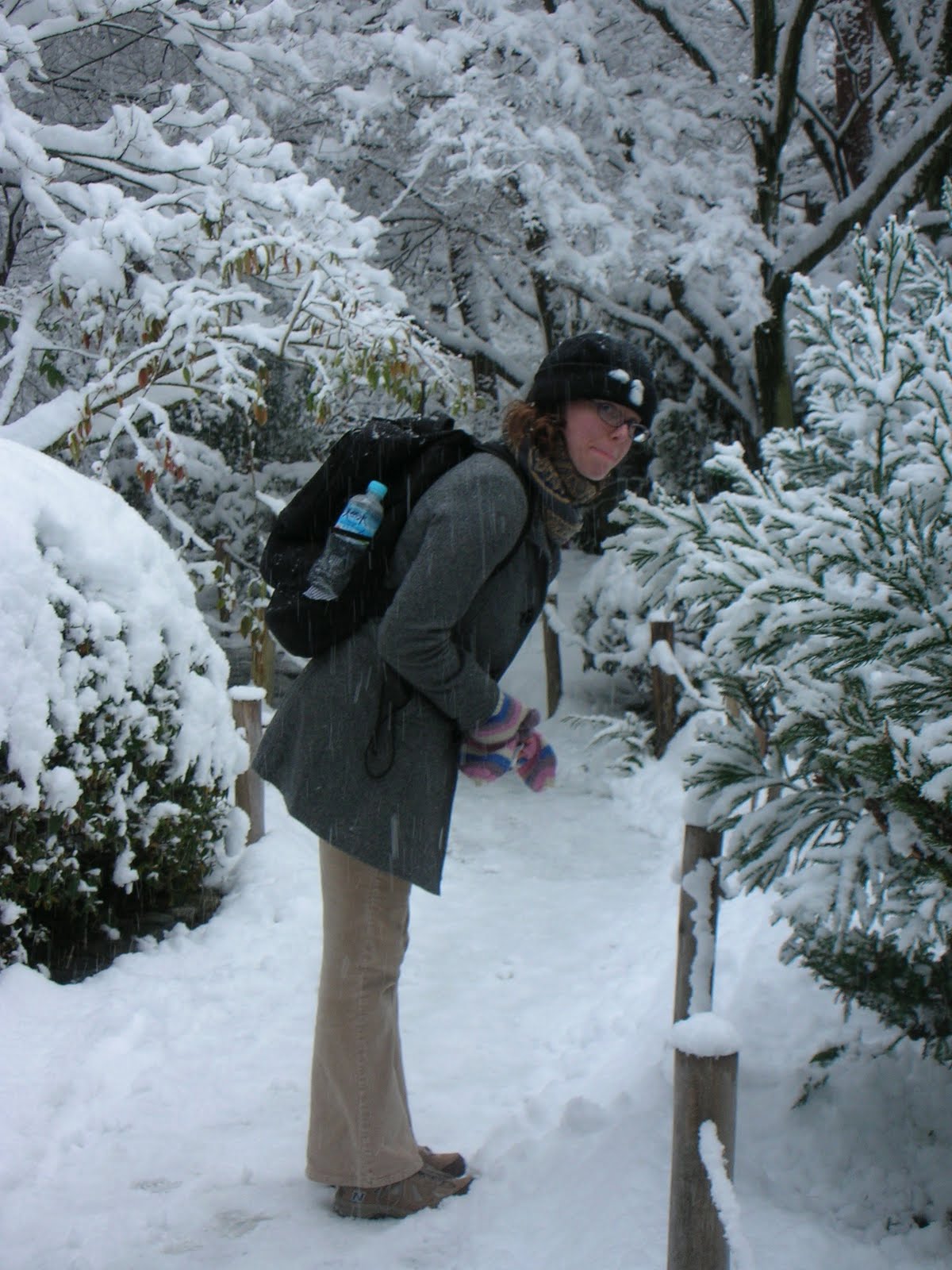
It was snowing in Kyoto as we picked out some gifts for our Malaysian friends. After wandering all over the station in search of one open establishment without a line out front, we gave up and hit the streets and were finally blessed with a deserted Italian cafe of lovely atmosphere.

From Winter Vacation Part I


We next set out to see Ryoan-ji in the snow.

Have water, will travel.

Which was gorgeous, especially the garden area out front.


The rock garden was interesting in the snow, but I think I liked the rocks better in summertime.

From Winter Vacation Part I


The area up near the pagoda was breathtaking, though.

You aren't supposed to touch these trees. I didn't know that, but Miriam read me a sign just as I was eating snow off the branches.


Huh?


We intended to see Ginkaku-ji in the snow, too, but by the time we were done with Ryoan-ji, it was 4:30, nearly dark, and closing time. So we went back to meet up with Nami and Hiroshi!

They took us home to treat us to New Year's, Japanese style, kinda. Which meant we hung out and talked for hours, munching on homemade cookies (courtesy of Miriam), chips and salsa, and other snacks. We taugh Hiroshi-san some English not necessarily found in his study program while Nami-san laughed at us from the kitchen, and watched NHK's New Year presentation (hosted by, who else but Arashi!).

At midnight, you eat soba as you cross into the new year, and we had a look at some osechi-ryori without actually eating any, because by then we were too full from having spent the previous three hours eating.

Not long after midnight, we just bathed and went to sleep. I'd gotten up at like 6am that morning, and was quite ready to call it a day!

It was really nice, though, to spend New Year's together with a family. The family of Nami-and-Hiroshi is a small one, but I've known Nami-san for such a long time, that she feels to me like my Japan family, like my big sister. She and Hiroshi are always so nice to me and whoever I happen to have come to Kyoto with at any given occasion.

From Winter Vacation Part I
Happy New Year!

On the 1st, we got to accompany the two of them to give the traditional New Year greeting to Hiroshi-san's parents. (Akemashite omedetou gozaimasu!) Though they didn't eat with us, they did give us a lot of the special foods for the holiday (osechi ryori), and we sipped sake and tea and sat in the formal room. Most of the foods in the osechi boxes had symbolic meanings, and sitting around eating them generally made me feel really calm and happy. I felt then, as so far, that this is going to be a very good year.

From Winter Vacation Part I
Pre-meal.. we're standing because once we sit, we're gonna be in seiza for a long time.

On our walk back, I saw a biking post-person delivering the New Year cards (nengajou)! When we got to the apartment, Nami-san put Miriam's nengajou next to my Christmas card (I sent a nengajou too, but Miriam's was home-made). Next we went into Kyoto city to make the New Year's shrine visit (hatsumode).

First up was Hiroshi-san's natal shrine, Yasaka jinja. It was absolutely packed. In fact, the entire district was packed. We couldn't even walk on the sidewalks, or not very well, anyway. Too many slow old people and stuff. Once we reached the gate, we elbowed our way up to the shrine where we tossed coins and said prayers. The first time I visited Yasaka, I said a little prayer to end the swine flu issues that were then effing up the lives of students everywhere (school closings, tubs of sanitizer, etc.) because Yasaka shrine was connected to an epidemic long ago (the stopping thereof, I mean).

From Winter Vacation Part I
Calm and peaceful, yes?

But I didn't have any swineflu to stop this time, so I made a little wish, and even in that roaring crowd, felt pretty peaceful. Everyone was buying fortunes (omikuji) but I didn't want to.. I don't really like to buy those very much, because I worry that if I read one, it'll come true, not because it was destiny, but because the stuff will get into my head, and then I'll make it all self-fulfilling prophecy. Off to another side, there was a booth for people to retire their old 2010 charms, things they'd bought last New Year's Day. I was surprised to see all these being basically thrown away, but as I was told, the charms have served their purpose, done their work, and now they can go. I guess if everyone kept every charm, they'd have craploads of the little (sometimes big) things hanging around. I personally will only be in Japan a few years, so of course I tend to keep them all.

Nami-san was reading to me the different aims of different charms. I almost bought "transportation," but then she translated another one as "opening up your future" or something like that. Pretty generic, but it was how I was feeling.

We got out of there and headed for Nami-san's home shrine, Shimogamo, but her father reported that it had taken him like an hour and a half to get in and back, so we skipped it in favor of going to her parents' house to eat and be merry.

From Winter Vacation Part I
Yay~!

Now, Nami-san is weird. Not in a negative way, but in Japanese way. Most Japanese people are vaguely interested in foreign cultures as long as they stay just like that, foreign. Fewer people want to actually get involved in foreign stuff.. but Nami lived in the US for many years, and even considered making it permanent. Having been to her family home, now, I know she comes by it honestly. It struck me as basically indicative of her family's way when I got their addresses from her to send thank-you notes after the trip. In the email she asked us to write to Hiroshi-san's parents in Japanese, and it was okay if we made mistakes. To her own parents she said English, Japanese, Hebrew, Russian, whatever we wanted to write was fine, and they loved getting postcards from anywhere. (We sent Hiroshi-san's parents a classy Thank You note.. actually left over from my graduation! And we sent Nami-san's parents a postcard we got in Kuala Lumpur)

So we got a great traditional cultural lesson with one meal, and just hung out at the other. Hiroshi-san made okonomiyaki in a style I loved better than either Osaka-style or Hiroshima-style. Nami's sister and I made takoyaki (yes, octopus balls) like pros. All too soon we had to leave to catch our train to Tokyo!

Though the day wasn't even over, and we were pretty tired, I have to admit that it was one of the best New Year's I've had, partly because it was very different from any New Year's I've had. It wasn't loaded down with expectations, but it was relaxed, educational, and warm of heart. I loved that.

From Winter Vacation Part I
The day isn't even over yet? (Stay tuned for Tokyo)


Monday, December 27, 2010

Himeji-Momiji PEPY Ride

At the risk of reaching too far back, I'd like to get this entry up now and be almost finished with my backward blogging!

The Himeji-Momiji bike ride was on November 13th, and it was a great success! We shortened the ride from the springtime because of restrictions on the daylight hours, and the way that the cloudy sky was making me want to take a nap.

But by and large, we had an awesome day, and raised 35,200 yen for PEPY!

PEPY is an organization which works with education in Cambodia. Education is an issue pretty dear to me, as I believe strongly that education of our children is essential for anything good to happen in the future. I sort of fell into working with PEPY (dare I call what we do "working with" PEPY?) because I want to take one of their bike-including tours of Cambodia one of these days.

Here is my post-ride report (edited for content/enhanced with photos for your viewing pleasure):

Team Name (prefecture): Hyogo

Team leader: EmLem, Chip Boles

Team members and nationalities: 19 people, American, British, Japanese, Canadian

Distance covered: about 25 km.

Date(s)/Time: November 13th, 2010, from about 9am to 5pm.

Amount raised: 35,200 yen

Cost per team member (travel to cycle route, bicycle rental, food, accommodation, etc): 500 – 1700 per person (bike rental 300, Shosha ropeway 900 or 500 or 0, depending on how much you like mountain hiking, 500 for entrance to Engyoji)

Please provide a description of your ride (including details of times, meals, weather, morale, sightseeing, anecdotes, anything else you feel we might like to know!):

Our ride this fall followed much the same route as the spring ride, although we had to trim some of the stops and activities because of the early sundown time.

We tried to time the ride to catch some momiji color on Mt. Shosha without conflicting with Hyogo’s mid-year JET conference.

We met at Himeji station at about 9am to introduce ourselves and sign waivers.

From Himeji Ride Fall 2010

After sorting out the bike rentals (14 people rented) and stopping to allow people to grab food for lunch if they didn’t bring anything,

From Himeji Ride Fall 2010

we were off to Sosha shrine, near Himeji-jo, where it just so happened to be 3-5-7 day (aka Adorable Children Festival), so we got to see a lot of 3, 5, and 7-year-olds dressed up in tuxedoes and kimono.

From Himeji Ride Fall 2010

From Himeji Ride Fall 2010

We moved on to Himeji-jo itself, which is almost invisible right now because of the restoration scaffolding, and took a group photo [note: still waiting on my copy of this damn photo], then headed for the Yumesaki River, which we followed north to Mt. Shosha. Some of us decided to hike up the mountain,

From Himeji Ride Fall 2010

while others took the ropeway.

We met at the top for our picnic lunches,

From Himeji Ride Fall 2010

then wandered around exploring Engyoji, the temple on top of the mountain.

From Himeji Ride Fall 2010

From Himeji Ride Fall 2010

It was the weekend of their momiji matsuri, so some of the temple buildings which are normally kept shut were opened up to public viewing.

From Himeji Ride Fall 2010

Also, the momiji were looking beautiful.

From Himeji Ride Fall 2010

After descending the mountain, we stopped for Taiyaki snacks at Marukura, where we gave the PEPY information and summary of how far we’d ridden and how much money we’d raised that day.

From Himeji Ride Fall 2010

From there, we returned to the station, then grouped off for dinner and later, karaoke.

From Himeji Ride Fall 2010

One thing that struck me as really fun was seeing the faces of Japanese children we passed along the way within the city itself. As the rear captain, I was the last foreigner they were seeing in a very long single-file train of them, and it was fun to hear their exclamations and remarks as we went by. It’s anybody’s guess what such a mass of foreigners would be doing on bikes in a city whose main tourist attraction is currently closed!

From Himeji Ride Fall 2010

The day was cloudy and a little bit chilly, which made us feel a bit lazier and had us moving a little slower (at least true of me!). This also meant it got dark as soon as the sun began to set, so we cut the last planned stop, “Bowser’s Castle” in Tegarayama park where we’d hoped to do a sort of Mario themed Easter-egg hunt activity. That, and Taiyo Koen, we will save for the spring!

Of our 19 riders, 7 had also attended the spring ride. A few were experienced cyclists and others expert grocery-store goin’ mamachari-ers. Everyone had a good time, and no one even needed a band-aid from my first aid kit! Special thanks to Miriam, who stayed in Himeji all day on-call with her car at the ready.