Sunday, September 30, 2012

Repatriation

It's been almost two weeks since I got back to the U.S., and although I have more Japan stories to tell, I really wanted to tell about Miyagi next, because I went directly (directly) from meditation retreat (on the eleventh day, you still get up at 4, but after the morning stuff and some cleaning, you may go along) to the northeast region to reach the Habitat for Humanity base by 6 pm. The distance between Kyoto and Sendai is pretty big, and had me driving (30 min or so) to a train station, where it was another 45 minute local train ride into Kyoto city, and from there a 2.5 hour shinkansen ride to Tokyo where I switched Shink lines (and bought a handy-dandy tourist pass called "East Pass") and then took another two or so hours to Sendai.

But because of a stupid move on my part, I don't have the photos yet for Miyagi in my camera. I do have the photos I managed to take with my phone (and upload before surrendering that phone's use) on the first day, which are pretty intense on their own, so I'm going to probably do what I can with those while I (or, my friends) work on getting my camera back to me here in the U.S.

So that should be the next entry, maybe.

Suffice to say that I was traveling a lot, and made it back to Shiso just in time to pack up, hit sports day (and its attached drinking party), and have a pretty good last weekend in town, capping off six weeks of living at friends' houses and traveling all the time.

I suppose if I want an explanation for my almost total lack of drive to do much other than unpack, study, read, sleep, sort things, watch TV, and attend Welcome Home soirees thrown in classic style by my parents, I need look no further than the calendar. Hitting the road for six weeks will take it out of you. Seriously. I just wanna hang out. I don't even really want to be entertained, and so if compared to my usual "two weeks to see everyone in Georgia" summer trips, my repatriation looks really dull and hermitlike.

But I assure you, so far, it's pretty awesome. I have a lot to do, and even though I feel like I now have nothing but time, I also still don't see enough hours in the day to do all the things.

I don't have any answers yet, my old room is a complex assortment of stuff I brought or shipped back, stuff I left for myself, and stuff that just sort of got left behind. I've got gifts that people gave me, and gifts I got for others, along with a bunch of other stuff that ended up in here after they moved it from the other rooms that underwent new occupations or major flooring changes in the last year. It's a process, and I'm taking my sweet time.

The Repatriation Roadtrip is about to be underway, in parts. I'm going to the Northwest first, via Denver, catching a ride with the (in)famous Kyle up in a zig-zag pattern through Utah and Yellowstone to Pullman, WA, where I will borrow his car and proceed west and north to meet more folks. I'm looking forward to my travels but it's hard to believe they're already upon me.

Kyle, circa 1999.

Aaaand circa 2009.
I'll be back October 22nd for a break, then hopefully it's off to do the Eastern Loop, Roadtrip Phase II which I am putting together.. But not very quickly. Cause you know, other stuff too. Like walking dogs and clothes shopping for the first time in over a year (yes really; I received so much last summer from departing JET Caito that I saw no reason to spend the money or dedicate the packing/shipping space to clothing I clearly didn't need), and excavating the closet, and stuff.

Oh, and my parents found me a car. (If I had a camera, I'd show you) ... I think I'm going to keep it. I think it might be named the Brave Little Toaster, if I do.

I had to convince my mother that this is a thing.

Apparently this is also a thing.

Culture shock hasn't been too hard, because it's been well expected. I kind of like freaking out at the grocery store and the feeling of wearing tank tops in public (scandalous!). Other aspects of things are weird, but they aren't quite getting the best of me. The best of me is like.. sleeping, or playing SimCity, or meditating, or vacuuming the floor.

Friday, September 14, 2012

no itch is eternal


I disappeared for ten days to attend a meditation retreat in the upper reaches of Kyoto prefecture.

So how was it? What was it like? What did you do?

Even as I was perpetually writing this blog post in my head for ten days, I’m not sure how to begin to answer those questions. Was it mind-boggling? Was it hard? Did you find enlightenment or answers or inner peace?

Well, yeah. Kind of!

Basic ground rules were things like total segregation of the sexes – so I lived, ate, and meditated only with the women in the women’s half of the center, walked in the women’s garden, and saw the men only in their side of the meditation hall and from across the driveway that separated our garden from theirs. Noble silence – that is, not talking, nor communicating with gestures – with the other mediators (you can talk to the staff if you need anything or to the teachers if you have a question, naturally). No lying, stealing, or killing (this includes eating meat, incidentally, so all the food provided was vegetarian).

For me, this was no big deal, and was actually kind of a plus. I rather like simple, healthy food – rich and/or highly processed stuff sort of overwhelms me anyway. The eating situation is kind of like being a kid again; there is what there is, and if you don’t like it, that’s just too bad. I think in itself this is a humbling technique. Also, we had fruit for dinner (not dinner.. teatime.. but it was at 5pm and was the last ‘meal’ of the day) which was sort of delightful. I’ve heard that it’s healthier for you not to eat after 6pm; I think I might’ve lost a little bit of weight!

Our days started at an hour I still consider pretty nuts.. but there and then it seems just like part of the lifestyle of the center, however temporary, you kind of get used to it.
Every morning, we’d be woken by the bell at 4am, chiming and chiming again to rouse us from sleep. From 4:30 to 6:30, we were to meditate either in the meditation hall upstairs or in our own rooms. 6:30 was breakfast, and a break until 8, when we would have an hour long group sitting session, meaning everyone would meditate together for an hour. At 9, we would get our morning instructions, and then meditate until 11 which was lunchtime.
At 1, we would begin to meditate on our own again, and then at 2:30 we’d start the afternoon group sitting. At 3:30, we would receive afternoon instructions and meditate until 5, which was tea time. During tea time, new students (me!) could have fruit, while old students (who had undertaken not to eat after noon) could have only tea or coffee or water.
At 6, we’d gather for the third and final group sitting of the day, followed at 7 by the discourse, for English speakers a video (for non-English, audio only) in which the teacher (S.N. Goenka, in India) would explain particulars, answer questions I was considering asking at question time, and in general provide a context for what we were practicing. After this, we’d return to the hall, meditate for a little while (the Japanese discourse usually took a bit longer than the English one, so I would have a break to brush teeth and otherwise prepare for bed) until 9, and then that was question time, or else bedtime if you had no questions. Lights out was 9:30, which seems early but ISN’T if you get up at FOUR.

If you’ve been counting, that’s about ten hours of meditation each day. You’re doing it constantly, like it’s your job, and for these ten days it basically is. During breaks, I was mostly walking in the garden, stretching, or napping. I started showering at 4 in an effort to be more awake for the 4:30 - 6:30 time slot.

And while it seems like being unplugged and not speaking would be difficult, I actually did not have so much trouble with that, personally. Occasionally I would wish to tell someone something, and more often I would think of some question I wanted to ask someone regarding my future travels or plans. In my usual life, when thoughts like that come up, I either make a note or address it immediately (send an email, etc.), but during the course I had no pen, I had no notepad, I had no email. So things had to wait.

How I felt about the meditation changed from day to day. Some days I felt great, I was feeling it, everything was going just as I wanted it to – I was alert, engaged, attentive, focused. Other days I sucked at meditation. I couldn’t stay awake, I couldn’t stop daydreaming or narrating or spinning my wheels, I couldn’t feel anything on my body. Sometimes I couldn’t have removed the serene smile from my face with a prybar, other times tears would be streaming down my face for no pinpoint-able reason.

And when I went to the assistant teacher at afternoon question time about day seven to say “Why can’t I get it to work today if I could do it yesterday?” The answer was this isn’t about getting it to work, this is about facing reality.

This isn’t about getting it to work. Contrary to my previous ideas on what meditation must be, what it must be for (sharper vision, clarity, quieting the mental noise, becoming more centered), this course is different. All those things are ancillary benefits and almost prerequisites to the real core of what Vipassana is supposed to be about, and what it’s really supposed to do for you.

Although it’s not religious or sectarian, the philosophy behind the technique is deeply grounded in Buddhist thinking. As we learned in high school lit and history classes, the basic tenets of Buddhism hold that life is suffering because of human desire – specifically in craving and aversion – which stands between humans and their freedom.

But how not to feel and act with craving for the wonderful things in life? How not to feel and act with aversion for life’s pains? “You have to go to the root level of these things,” they said. I pictured each person carrying varying sizes of mountains of personal baggage, I imagined the kind of time it would take to peel all those layers back (some much longer than others) to get to the ‘root level’ underneath it all. How could any person uncover or even hope to glimpse this so-called root simply and within the span of ten days?

The simplicity of the answer to that still makes me laugh a little – I am seeing this root as buried beneath the issues of a person (therefore inaccessible without removal of said issues), but it becomes clearer to me that it can be accessed fairly simply because it is the first level of understanding, the most basic level of reaction in a person’s experience – the sensations of the body.

So what the technique teaches is, to become aware of sensations on the body, both pleasant and unpleasant, and to not react to them. To feel an itch, to observe it, to not seek its immediate undoing but rather “Let me see how long it lasts.. well, because no itch is eternal.”

And by so doing, to understand at the level of physical experience that which everyone already knows intellectually, that nothing lasts forever. That every feeling which arises also passes away, that every thing which lives also dies, that every object crafted or built must eventually, eventually decay and fall away. And if nothing is permanent, then why get so upset, why get so attached?

It makes sense; we all know that this is naturally so. Build something out of stone and it will last longer, but even that is not forever. Everything good needs replacing. Change is all there is. We know it, we know it. So why do we still get all bent out of shape?

The message behind the meditation is there is this huge gap between knowing something intellectually and understanding it in a way that really sinks in and applies to your life. This gap is the difference between hearing about something, reading about it, knowing about it, thinking about it .. and experiencing it for yourself.

The endgame being something like, being able to enjoy good things without reacting to them with clinging and craving, and to endure the unpleasant things without panic and aversion, to maintain equanimity at all times with the understanding that this too shall pass.

I can say that personally in my own life, I recognize a heck of a lot of examples of particularly clinging-reaction behavior. I have always been loath to let a good thing go (and my life has been above-averagely full of good things, so while it’s ironic to think that these good things could cause me suffering, well there you are). But as I look ahead to the changes that are coming (goodness, is it four days left in Japan now?), the unknowns that characterize the road ahead, I feel really okay about it. People ask how I am doing and I say good, and I really mean that. Maybe this was supremely well-timed.

During the course, various people would pop into mind, people I thought should look into it, people I thought should try it. I wanted to say, this is for everyone, and it is! But it’s also not for everyone. I don’t know. It’s hard. It’s a little out there compared to the normal everyday life of myself and most of the people I am close to. I loved it, but I also hated it; I wanted to run away, I wanted it to be over. I hesitate to recommend something that was painful to do.

And when I say painful, I kind of mean physically. Sam has been trying to work with me on the muscles of my core, how to properly distribute the work of holding the body up. My back pretty much hated me most of the time I was there; I fell asleep lying on a golf ball (self-massage, trigger point style) more than once during lunch breaks. During the sittings of ‘strong determination’ (about the second half of the course, the one-hour group sittings become attempts to sit for the entire hour without changing your position) I understood the poetic description ‘singing with pain.’ Hips, knees, feet, legs all in rebellion, back and shoulders going on strike. Parts of you falling asleep, or worse yet, coming awake. I want to tell people, it’s so great, but I also don’t want them to think that’s all it is. It is great, but at times it also sucks. It’s like medicine, it’s like exercise: you don’t always do it because it’s enjoyable in the moment. You do it because it does something for you.

Basically, to really understand it, you have to do it yourself! That was another message that was emphasized there… no one can give you this understanding, you have to find out for yourself. And you shouldn’t just take someone’s word for it, you should pass your own judgment based on your own experience!

Look at this website, see where the centers are, read all the things, and decide for yourself!


If my sojourns to temples is something like Buddhism light, this stuff is Buddhism pure – kind of at that depth of level where religion isn’t really religion because you’ve stripped it of all the rituals and rules and what’s left is just help for self, help for others, and love.

Tuesday, August 28, 2012

I've been blogging my best in the down time I've had to try and get the temples (are you tired of them yet?) and other adventures covered before I "run out of time" and then somehow never get around to writing them, which knowing me is a likely scenario.

Those in the know may be aware that I'm back to the US in mid-September, which if you're counting, is still like three weeks away, so I should therefore have plenty of time to 1, finish all 33 temples, 2, blog about them, and 3, see and spend time with all the friends I've yet to properly do farewell activities with.

And that would be true, but for the way this is all booked up. In a good way, and in important ways, of course.

I think I've been trying to blog the temples now because I think my perspective on them will be different on the 'other side' of the next excursion, is all. I mean, I did keep a little notebook of impressions from each temple visit, and the website where I got all my info will still be accessible (seriously, are you not tired of them yet?).. the only thing that could possibly change is my point of view.

There's just too many temples and other adventures to write about before tomorrow evening, though, so I doubt I'll make it, and we'll have to be content with whatever I manage either tomorrow morning amongst the other duties, or whatever I can come up with once I've finished my next adventure.

I guess also it's possible that the next adventure will take up a pretty significant chunk of attention.

Starting tomorrow evening, I'll be joining a Vipassana course for the first time. I almost don't know what to expect, except I've read JET accounts, and heard from and about those who have done it..


I first heard about the course from Yut while we were in Cambodia, having out wonderful sunset talk (which I refer to mentally as the 'sermon on the mount' .. yeah I know I'm out of hand) which led to our incredible nighttime bike ride (and my plowing straight into a mountain of gravel, woo!), and it was immediately a thing that sounded like it lay in the direction of my alley.

Since then, I looked it up online and realized that in order to have ten straight days of free time, I would have to wait til after my contract, or else once I was back in the US. I preferred to do it in Japan, though, because it just felt like a more.. Buddhist place, I guess, than say, south Georgia. I wanted to try this for the first time in the setting of the place I was preparing to leave. Later, it will maybe be fitting to do it in the place I am going back to.

So what I'm trying to say is, I'm going to go tomorrow to a meditation center in Kyoto (when I say Kyoto, it sounds like a fancy Japanese temple in the old capital.. but what I mean is Kyoto prefecture, an area just over the border with north Hyogo, and probably in a mountainous countryside inaka hideaway just as remote as any inaka I've been to), where I'll hand in my cell phone and books and notebooks (what?! No note-taking?! How will I manage?) and try sitting still and listening inward and not speaking to anyone for ten full days.

When it's over, I'll tell you all about it, or as much as I can, because I get the feeling that it's something you can't explain so well as do (not that I think the doing is easy, mind you).

Once that's over I will head directly to Tohoku to commence a short volunteer project with Habitat for Humanity. This might be a terrible idea just after mediation, or might be really perfect; I've yet to figure it out and probably won't know til I'm there. After spending a few days in Miyagi and then Akita (Akita not disaster zone, just a friend visit), I'll head back to Shiso just in time for my final weekend.

So in many real ways, heading into meditation is the beginning of the end for me.

I still have a list of things I want to blog (performing arts in Kyoto, Daigo-ji and Sanjusangen-do [temples], the wervs visit to Kagoshima and Ibusuki, Nakayama-dera and Katsuo-ji, Soji-ji and Fujii-dera [temples], Wakayama and couchsurfing, Kokawa-dera and Kimiidera [temples again... no but really I bet you're sick of it]) but they will have to wait.

Because for all that I run around and want to do everything, for all that there's never a dull moment, I think it will be really good to slow down, really important to be quiet.

So when you can't get ahold of me for the next two weeks, now you know why.

Monday, August 27, 2012

Crossroads, Centerpoints, and Sixes: Temples 17 and 18

Friday morning, I essayed out to return to north Kyoto, drop off my stuff with and gather Miriam, and we headed for temple number 17, Rokuharamitsuji. ‘Roku’ means six, so that might serve you for the rest of this post.


 Roku-hara-mitsu-ji is named because it is built at an old crossroads where people too poor to afford proper burial were dumped. But the six of the name refers also to the idea that it’s a crossroads of six realms through which souls wander, that of hell, hungry ghosts, animals, titans, humans, and gods. It’s in the middle of a slightly more run-down sector of the city (compared to the bustling tourist centers easily spotted all over). The temple itself is bright, and on our visit was filled with lanterns (not lit, since it was late morning) and fairly bustling for a weekday morning.


Some of the most interesting things were in the museum, including the statue of Kuya, who is portrayed with a line of six tiny Buddhas marching out of his mouth to symbolize the chanting he was famous for.

Another part I really liked was what I thought of as the ‘water section,’ off to the right of the main hall. Photos were not allowed, but in this area there were statues (I specifically remember a Jizo with babies and a Benten, and also a guardian kind of deity) over which people would fling or pour water from ladles at the base of each as an offering, and maybe purification for the self, and also (I think at least in the case of the water babies) a sort of sending-along to speed them on their path to incarnation.


After I’d had my turn at watering them, we moved on; Miriam again had to go meet a student, so I went on to Rokkaku-do alone. As you may have surmised, there’s a six in this one too. Rokkaku-do means “six-sided-hall.” Six-sided styles of temples are apparently a very old type for Japanese Buddhism.

Rokkaku-do is in the center of Kyoto, surrounded by classy looking glass buildings (indeed, I will confess I had a drink at the adjacent Starbucks after visiting the temple), one of which is the Ikenobo building, as Rokkaku-do is the place where ikebana (Japanese flower arrangement) was developed. The temple complex (like Rokuharamitsuji) was pretty compact compared especially to the mountainside temples which cover a lot of ground, but it was a very peaceful place. They also had the best incense lighting system I’ve seen (though it confused the heck out of me at first).

Incense holder

Ikebana HQ

Door to Starbucks
 One of my favorite things here was the presence of water. There were little flowing pools all around, one of which was inhabited by white swans, another surrounded by sixteen Arhats, which represent the idea that no matter which of the sixteen compass point directions you go in, there will always be one of them to bring you back (to the center? ..to enlightenment!).

Arhats


One-word Jizo, meaning if you make a prayer in one word, he will be able to help you.


 Rokkaku-do is about the center because it has the Kyoto center ‘bellybutton’ stone, showing just how in the middle of Kyoto it is. To me it was about taking a second to get centered, even in the middle of a bustling city. On this day, Rokkaku-do was less crowded than Rokuharamitsuji, though I now think that might have been because of a festival going on in the Rokuharamitsuji area.

Bellybutton stone!
 After my chai tea in a plush chair looking out into the temple yard, I headed back to Miriam’s, my two temples of the day confirmed.

Sunday, August 26, 2012

Hasedera (number eight) and the bonus temple


Having passed out early, I had no trouble getting up extra early the next morning. I dressed and slipped out about 6 to make my way up the steps. I went around the side entrance because I thought the blocked main gate still applied to me, and heard chanting coming from one of the buildings off to the left. I found my way to the main hall where I looked stupid until someone was kind enough to take me in hand and tell me where to go to get my ticket.

The street to Hasedera at six am.
It was a Thursday at 6:30, so I was the only guest at this morning event. Every monk that passed me bowed and said good morning in a way the reminded me of being at school, and how the kids are always told to give a really energetic greeting (in fact, one of the monks struck me as really young.. like maybe middle school age, and I thought, what the hell, why isn’t that kid in school?! until I remembered it is summer vacation right now ^_^). I couldn’t tell if the guy sitting just next to me explaining stuff was high ranking or just exempt from some of the niceties in order to take care of me, but he was never the first to say good morning. He handed me a book in which was written the text of the prayers and chanting, including in some parts these little notations for how the syllable was held and whether the note went upward or downward or squiggled.

This is the area where we were assembled. I was sitting in front of that thingy at far right, with my back to it.

He showed me where the leader would speak and where the assembled monks on the area where I was sitting (and theoretically I too) would respond or be chanting. He explained how the second part would be chanting along to a drum beat from within the temple. Then we had a little extra time so he told me about the temple building itself, how old the statue was (third temple in a row where the main image was just right there in front of you), and some other features of the place. I nodded a lot, said ‘hai,’ a lot, and was glad I already knew gassho-rei from kempo practice (that’s the kind of bow that isn’t so much a bow as a hand position).

My Japanese isn’t good enough to chant along, especially once that fast paced drum got going, but I did like listening to all the monks chanting together around me, and I followed along in the cool book he had given me (which was folded kind of accordion-style, so turning the pages was also an act of stretching and I could look at as few as two, as many as maybe six pages at a time! Useful when I lost my place). After this, we did a sort of morning salutation prayer (I think?) standing and facing the mountains in a few different directions visible from the main platform.

This is a photo of a sun-worn poster, but it shows what that part looked like.
Stairs.

Afterward, I walked down the main path with its 399 stairs, falling into step beside an older guy who talked with me pleasantly a little bit about where I lived and what I did before bidding me good morning and disappearing off a side path. I took the rest of the steps and returned to the ryokan for breakfast.

I always take the photos sans soup.

After breakfast, I went back up to the temple to explore some more, seeing as how I had no further buses to catch. Hasedera is called the Flower Temple, and I could see where lots of things could be blooming at different times of the year. Naturally in August only the cicadas were in full bloom beneath the swelter of the sun. The mountain trees, though, gave a nice shade to my wanderings.

The whole place is beautiful, though, and has a calm, sweet feel. I like the way the main image of Kannon is holding Jizo’s staff (according to my sources, this is rare) symbolizing her ability to travel to any place at any time. (Click that link to see a photo)

While I was getting my stamp and seal, I was asked if I knew about the “ban-gai.” These are three temples listed in the back of the seal book, not counted amongst the 33, but which are still part of the pilgrimage for other reasons. That ‘gai’ is the same as the gai in gaijin, and it just means ‘outside’ .. so the ban-gai are the temples outside the ‘ban’ or order/numbering. I know almost nothing about the ban-gai even now, and knew utterly nothing then other than that there were some.

He explained that one of the ban-gai temples was located just down the road (and in fact, basically right next to my ryokan), so I shrugged and thought, I’ve been to two temples every time so far, why not keep that tradition going? I do feel a little weird about going to temples I have absolutely no information about. I always look to the Sacred Japan website in order to sort of ground my travels; it’s almost a ritual now. On the bus or train to a place, I peer into my smartphone and read (or in most cases review) what is said there about whatever temple I’m on my way to. It makes the whole experience a bit more meaningful.

After all this, I made the same mini trek to the train station, which was no more fun in reverse being as it was late morning and this time uphill. I returned to Nami-san’s house with the intention of going farther, but I never made it and ended up just hanging out with her and Hiroshi-san all evening and staying another night. It didn’t occur to me til then that I might not see them again for a while, and I just couldn’t get myself out the door with that in mind.

Monday, August 20, 2012

Temples number Six and Seven: Okadera and Tsubosakadera

I returned to Kyoto on Tuesday evening, arriving at Nami’s at just the time I had planned to on the first calendar (that is, the one that had me in Tokyo from Saturday until Tuesday early morning), and so things resumed as planned from there.


Typical.
I love visiting Nami’s household, but it can be sort of like a time warp. Time slips away at a faster pace than other places, and before we knew it, we had chatted later into the night than one would necessarily want, having spent the whole weekend traveling and preparing to get up at 6 the next morning.

Yeah, 6 am. It turns out (and I wouldn’t have known this without their help) that it takes a very careful schedule to make the buses and trains necessary to get to both Okadera (7) and Tsubosaka-dera (6) in the same day, although they are relatively close together on the map. I was due to take the same train in the morning as Hiroshi-san was taking to work, so we ate breakfast like a sort of cobbled-together family… the married couple and their adopted foreigner little sister, and then he and I hustled to the train station. I thought we must look funny together, he in his working clothes like any other Japanese working guy, me with my pack and walking shoes like any other tourist… neither is a particularly rare sight in Kyoto-Nara area, but to walk and talk and sit together on the train is something else. Nami-san waved to us from the balcony of their apartment as it flashed by, and we were off.

My first destination was Okadera, one of the oldest temples on the route snugged up in the mountains of Asuka, which is the most ancient first capital of Japan (and you thought it was Nara..! Well, I did anyway). Asuka, it turns out, is an area full of ancient things, archaeological stuff. Other than that, it’s as countryside as countryside can be, which is why the public bus runs only a handful of times a day on such narrow roads and was so sparsely filled.


Attempt to capture the field of lotus blooms... fail.
Okadera was perhaps the first temple I was earnestly able to make it to in the morning. The feel of the place as I walked up (sweaty as ever, despite the morning hour, having gotten a little lost already thanks to some construction work) was relatively empty; I paid my entrance fee as though I had managed to catch a tourist spot unpopulated for the first time in Japan.


The main hall from above on the mountainside.
What set in my mind first was the mountain-garden feel of the pathways I followed through the woods there, and the insects.

Okadera is famous for protection against disasters, and I saw part of what I think was a ceremony or prayer for a woman at one of the vulnerable ages. There is a list of the vulnerable ages for women and men on the bell tower; I’ve seen these lists before, and Okadera is pretty big for trying to make sure those bad years go well. I was pretty sure I heard the priest say “thirty-three” during his chanting, so I sat still and listened for a bit because I find the chanting and bell ringing that goes on pretty soothing.

View of Asuka from near the pagoda.
Okadera is also perhaps the first temple where I was able to see the main image of Kannon. At many of these temples, the image is not seen except every 33 years or so (some places, not at all, ever), but at Okadera, she is in full view all the time. The statue is a large clay image, the largest clay statue in Japan, and it has a really earthy look and energy about it. It has been restored often, but has essentially survived since the 700s, which is what gives it the reputation for protection against disaster.

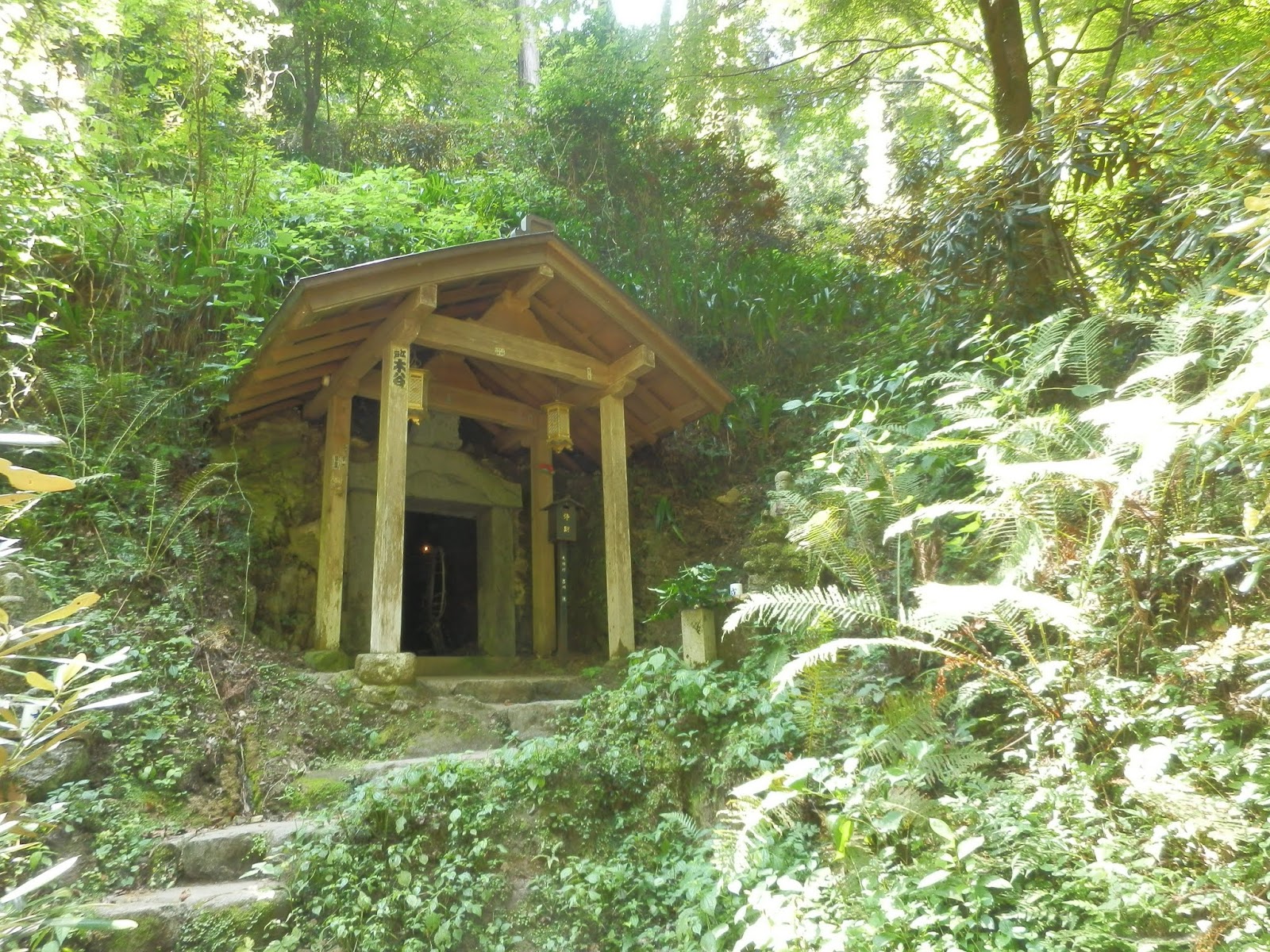
I took my time exploring around a bit, eventually coming to the Okunoin further up the hill. That’s the inner sanctuary, which is often tucked away somewhere further up the mountain. This one was a little cave which went back into the earth rather farther than I expected from looking at the front of it. There’s a small statue inside of the Buddha of the future, and an older couple who was praying in there ahead of me (I waited til they finished because there was actually not enough room for more than two people side by side in front of it, plus I always feel awkward when those I regard to be the ‘legit Buddhists on legit business’ are doing their thing and I’m just wandering around spectating) gave me a piece of tarp to sit on because the cave was damp and puddle-y. After sitting inside a little while, I stood up and noted how the cave at that point was just barely tall enough to accommodate my height, though I couldn’t walk upright through the cave. Then I noticed just just above my head a pair of the biggest effing camelback crickets I have ever seen, and I crouched right the hell back down, packed up my piece of tarp, and with one more bow, hurried back out into the light.

Entrance to the cave...
So, yep, bugs and mountain-garden foresty earthiness. It was a beautiful place and I’m glad I got to go in the morning when it was so quiet and peaceful.

I next caught another bus to a tiny train station (Asuka), from which I was to proceed by train to another train station (Tsubosaka-yama) and wait for a more different bus, which would not come until 1:15, although I had to get on the first of these buses at 11:06. This meant I would have time for lunch in the train station area, and here is where I made a Saiou’s Horse kind of mistake.

Asuka station was flanked by your usual handful of little restaurant places, none of which looked particularly good, so I decided to eat in the area of the second station. Getting off the train in that area, I looked around, noted it to be a touristy-looking street ahead of me, and decided to wander til I found something, since I had nearly two hours to kill. The sign above the road said that the town was one of “sightseeing and medicine,” which I thought odd, but shrugged off and began to walk with my little parasol overhead. I wandered in a sort of loop for twenty minutes or more, finding that every single likely looking place I came upon was not a restaurant, but instead a hair salon, dentist, or other treatment facility, and half were closed. There had been one well-marked restaurant just by the station, but the sign on the door said “closed today.” Ah the perils of traveling on quiet weekday afternoons.

Oh why are you closed...?
I returned to the station along a sweaty, perilous highway with a tiny sidewalk and asked the station guy about food. He pointed to the tiny closed place and I protested its closedness. He shrugged sadly saying, that was it. I sat down on a bench to reconsider. This was crazy. Not eating was unacceptable; I would have to find a combini or something.

It was then I remembered that I do have a smartphone and it is good for more than just email and mapping exactly where I am. It also has a ‘find restaurants in my area’ function, of course. I put it to the test. The first listing was for a place half a kilometer away, not so bad, and a ten minute walk according to the review written in Japanese. The place was just past where I’d come upon the perilous, sweaty highway, and I did not relish taking that walk only to find the place ALSO CLOSED, so I did the thing I always dread doing, prepared myself for Japanese and phoned the place. I was about to give up hope when an animated voice answered pretty late in the ringing cycle, confirmed that they were open, and that it was a ten minute walk from the station. I needed no more than that, and set off.

The place was across from a combini, and I briefly considered grabbing some quick food there instead, because now I was beginning to worry I wouldn’t be back at the station in time to catch the bus at 1:15 if I had heard right and the restaurant I was headed for would take some time in food preparation. But I thought I saw a bus stop sign just a little further ahead and felt sure it must be on the route I wanted, right? And if it all went to hell I’d just call a taxi and catch up with my schedule later.

I then stepped into the restaurant and had the best damn udon I’ve ever eaten, and I’ve been to Shikoku AND I don’t even like udon, but I was supremely glad I hadn’t given up and gone to Lawson’s. The lone guy running the place was apparently making the stuff from scratch, and it was a beautiful thing. If you are ever in the western end of I-think-I’m-lost Nara prefecture, I give it a thumbs up.


My food was ready in about perfect time for me to eat it, pay, and get to the bus stop which was in fact the bus I wanted, which took my up the winding paths to Tsubosaka-dera. Tsubosaka-dera was, once again, totally different from the other temples I had been to so far, especially in its palpable connection to India and Indian Buddhism. Without really solidifying in my head what that image is, I have formed an idea of what a Japanese Buddhist temple looks like, but Tsubosaka-dera does not look like that. The imagery was different, the atmosphere followed suit.


This temple is connected especially with sight and eyes, not only in the prayer sense, but also in the very real sense that there is a home for the blind on the premises. The connection to India is in their ongoing support of programs in India. This temple therefore felt like a museum in some ways (I mean, there was a wall, a relief carved wall with stories from Buddha’s life!), but also like a functioning thing, not a relic. 

This statue is related to a legend associated with the temple about a man healed of his blindness.
Maybe because it was a weekday afternoon and tucked far away up on this mountain, but there were hardly any other visitors that I could see. I walked around a little and made my way to the main hall, where I slipped in quietly and looked around. The main statue here is also visible to those in the hall at all times, this one because it is meant to be seen, in connection with its healing for sight issues. Just as I was about to head out and explore the grounds some more, a large group of older-ish Japanese folks had massed at the entrance, looked like they had come by big tour bus, and were being given a short lively speech by the guy I’d nodded to solemnly on my way in. I passed the merry crowd and walked again through an area that made me think someone was burning lavender incense until I realized I was surrounded by lavender plants being baked in the sun.


Made in India, actually, then shipped over and reassembled in Japan.
I checked out the great Kannon, and reclining Buddha, and inspected the building that is covered with tiles made to imitate the ancient tile found in the area, and tried some of the eye-healing tea. I knelt on the power stone, and asked for clearer sight, to which I swear I heard Kannon-sama chuckle and say, get lasik, you.


The last bus out was at 3pm, which I at the time thought a bit strict, but found to be perfectly timed for me that day. I bought a bottle of Tsubosaka spring water and beat it toward Hasedera. The final walk to my ryokan for the night was pretty sweaty, given that I was wearing a backpack and walking for over a kilometer even if it was through cute streets (the kind that lead the way to important temples or shrines that get a lot of visitors… these kinds of streets develop with gift shops and inns and restaurants to serve the travelers, even from really old times). It was just after the heat of the day and I was beat.

I took this before she brought the soup out even.
I was the only guest that night at Yoshinokan, so I had a little tatami room all to myself. I bathed, put on the provided yukata, and ate my fancy Japanese dinner while watching the Olympics with the proprietess. Then I took a little walk up to Hasedera’s steps and back along the small river. I thought maybe it was kind of neat to have walked up to temple number eight on August 8th, even if I wouldn’t really go in til the following day. Nami-san had set me up to stay the night basically at the temple doorstep so  I could attend the morning prayer service which is open to the public.

Once darkness had fallen, I retired to my room and happily conked out at about 8pm (perfect for a 5:45 wakeup, if you ask me!).